A plumber who works mostly around Harrisburg walks into a basement expecting a forty-gallon gas heater and a B-vent. Here that is a rare sight. Natural gas is the primary heat in 1.0 percent of occupied homes, twelve of 1,199, against 38.3 percent across Dauphin County. Fuel oil heats 42.9 percent, and electricity heats about half.
So a water heater here is electric or propane, and the propane ones are either a storage tank or a tankless unit on the wall. Each fails differently. The general treatment — repair or replace, sizing, anode rods, tank life — is on our water heater page. What follows is what is different here.
Electric tanks
An electric heater has no burner, no flue and no combustion air requirement, which is exactly why it ended up in so many houses on streets with no gas main. It has two heating elements and two thermostats. The overwhelming majority of no-hot-water calls on one come down to a failed element or a failed upper thermostat, and both are inexpensive parts.
Two things catch people out. The first is recovery: an electric tank reheats slowly, so a forty-gallon electric in a house that gained a second bathroom will feel broken when it is only outmatched. The second is sediment. A lower element buried in scale is heating the scale, not the water, and it burns out early. Flushing once a year is the cheapest maintenance in the building.
If a heat-pump water heater comes up, the honest caveat is that it takes heat out of the air in the room it stands in. In an unheated basement here in January that is a real trade, and the unit needs air volume around it to work at all. Some basements suit one. Plenty do not.
Propane tanks
Where somebody put a tank in the side yard, the heater behaves much like a gas one, with two differences. The orifices are sized for propane and are not interchangeable. And the supply is a tank rather than a main that never runs dry. A heater that goes cold in a cold snap is sometimes not an appliance fault at all — it is a tank that cannot vaporize fast enough at a low fill level in single-digit weather.
Propane tankless
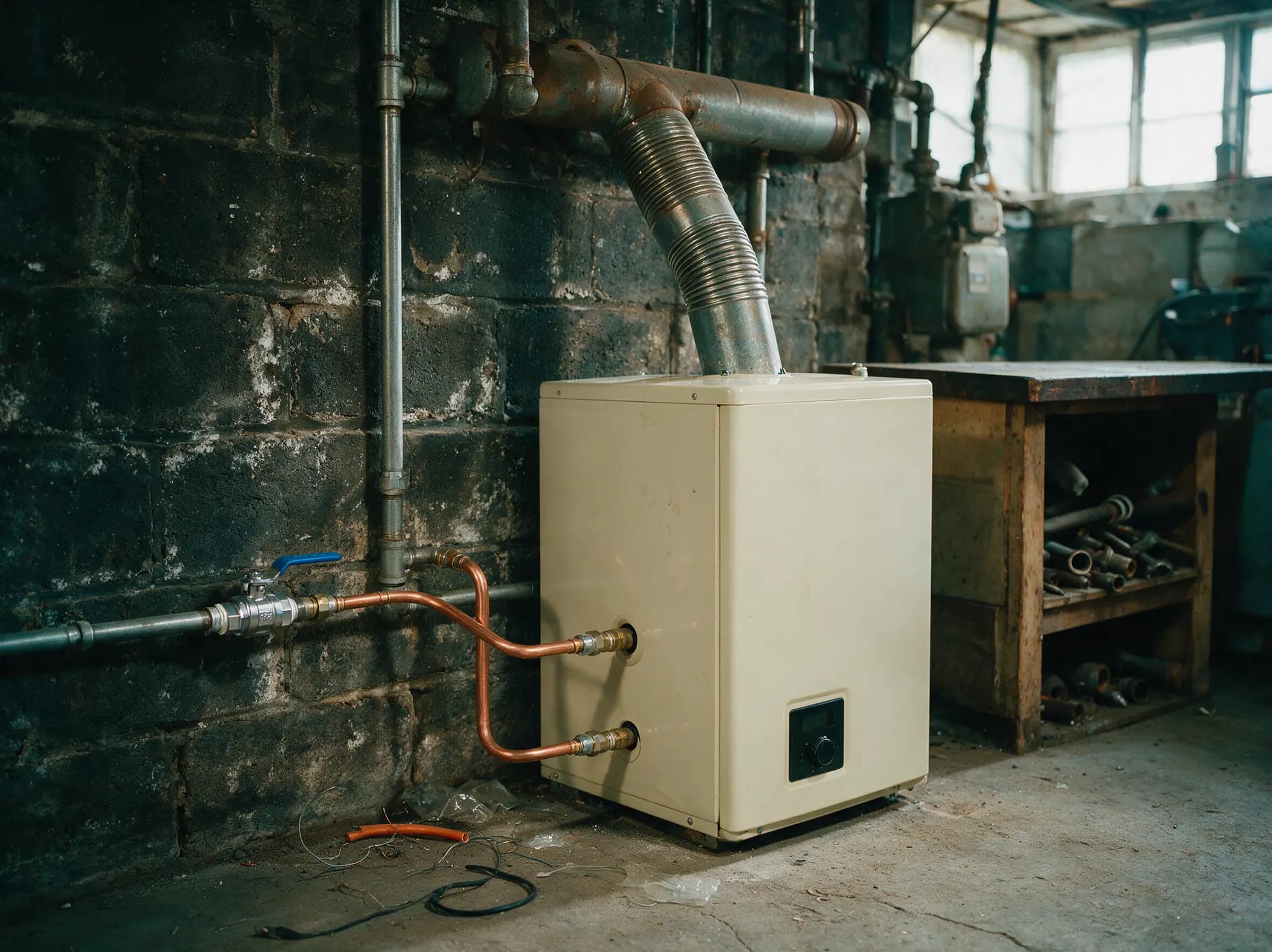
A propane tankless unit hangs on the wall and fires only when a tap opens, so there is no fifty-gallon cylinder to carry down the stairs and no standby loss. It suits a household that runs hot water in long stretches. What it asks of the house is the real cost: a direct vent out through the wall, a supply line and regulator big enough for a burner that draws far more at full fire than a tank heater does, and a dedicated electrical outlet.
Hard water is the other thing. Scale builds in the heat exchanger and the unit starts throttling back or throwing error codes. A tankless heater on hard water wants an annual descale through its service valves, and sometimes a softener ahead of it does more for its life than anything else.
Fitting a modern heater into a 1955 basement
The median house in the borough was built in 1953, and the largest single block of housing, 263 units, went up in that decade. Those basements were laid out for a shorter tank, an oil tank in the corner, a coal-era chimney, and stairs nobody expected a fifty-gallon cylinder to come down.
- Height before diameter. Modern tanks carry thicker insulation and stand taller than their 1970s equivalents at the same capacity. Overhead ductwork and the underside of the stairs decide this more often than floor space does.
- The route in. Nearly a quarter of the borough’s housing is attached or twin. In those, the only way to the basement can be an outside hatch or a turn on the stairs that a full-height tank will not make.
- The floor. Stone and block basements often slope toward a drain. A heater wants to sit level on something solid, not shimmed up on a wedge where it will work loose.
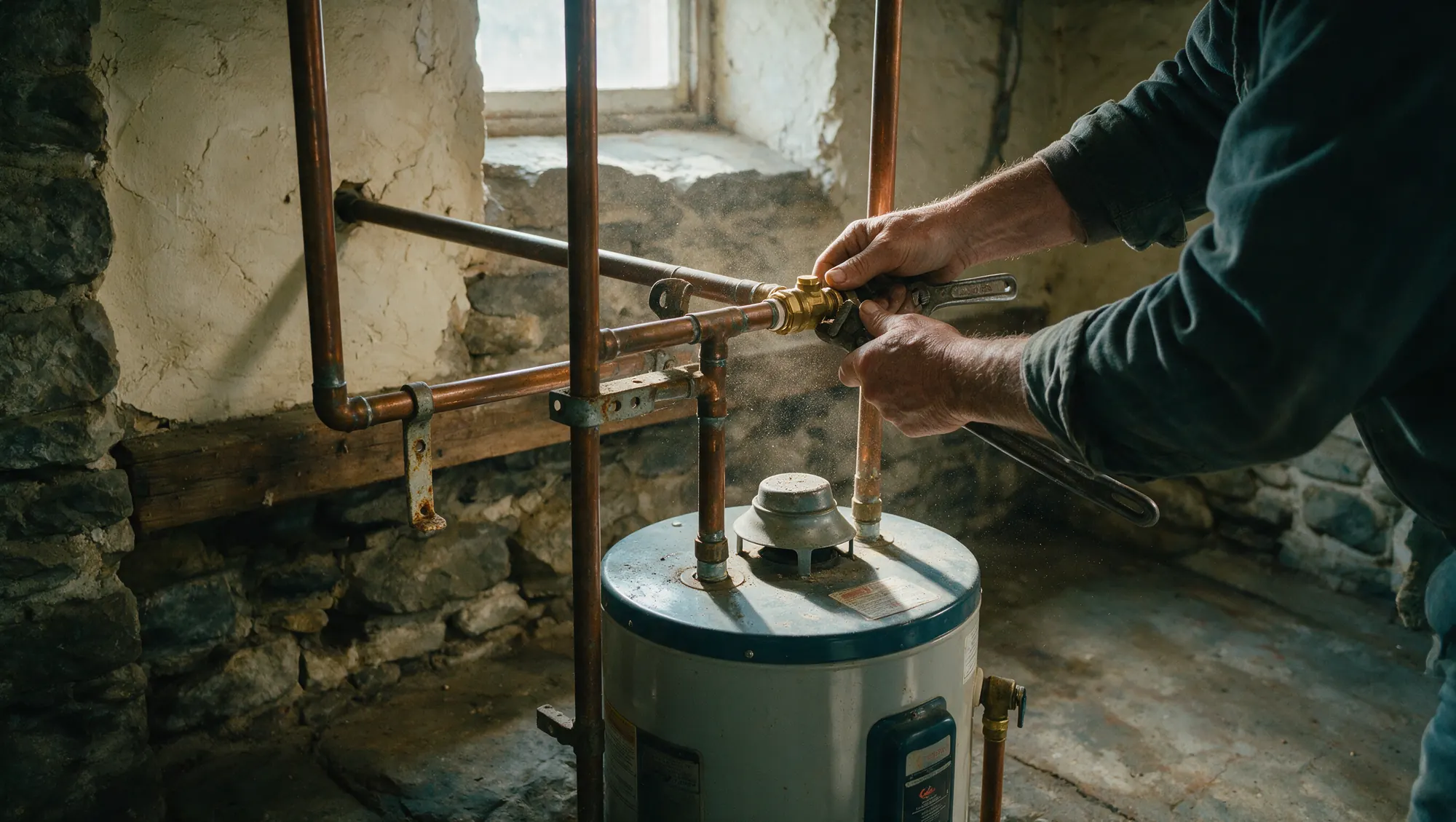
- The last few feet of pipe. Half-inch supply and 1950s solder joints at the heater connections. We replace those stubs rather than reuse a fitting that will weep three weeks after we leave.
- Natural gas heat
- 1.0% — 12 of 1,199 homes
- Fuel oil heat
- 42.9%
- Electric heat
- About half of occupied homes
- Median build year
- 1953
The general version
This page covers what’s different about water heaters in Millersburg. For how we approach the work generally — the diagnostics, the repair-or-replace reasoning, the parts — read the main page.
Water Heaters