You’re in the right place if
- One sink or tub draining slowly
- Every drain in the house is slow
- Basement floor drain backing up
- A drain that gurgles
- Sewer smell in a bathroom
- The same drain clogs every few months
A blocked drain tells you more than people give it credit for. Which fixtures are slow, whether it gurgles, whether it only acts up when something else is running — that pattern is most of the diagnosis before anyone has touched a tool.
Clearing the clog is the easy part. The useful question is what it was telling you, because a line that blocks once is an accident and a line that blocks every spring is a defect. We clear drains across Upper Dauphin County, and we’ll tell you which one you have.
What we handle
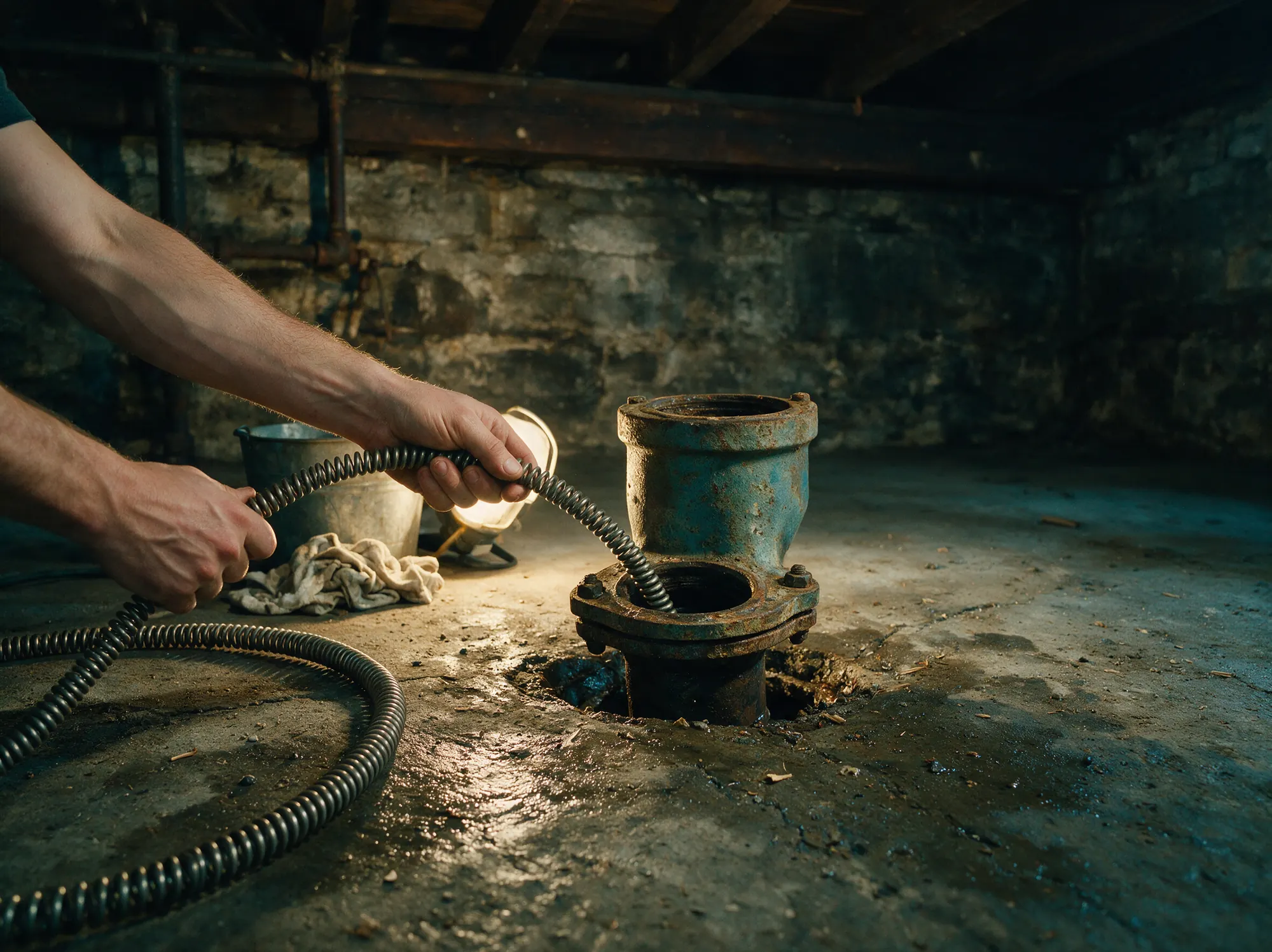
Slow sinks, tubs and showers. Toilets that won’t clear. Kitchen lines coated in grease. Basement floor drains that back up when the washer empties. Main lines and the lateral out to the street or the septic tank. We cable what needs cabling and jet what needs jetting, and the two aren’t interchangeable: a cable makes a hole through a blockage, jetting cleans the pipe wall, and a greasy kitchen line that keeps closing back in usually needs the second.
If the pipe itself has failed — a collapsed section, an offset joint, roots at every joint — that stops being a cleaning job and becomes sewer and septic line repair. We’ll say so rather than clean it again.
What we see around here
Where the water goes changes the answer. Inside the boroughs it runs to a public sewer under the street. Outside them it runs to a tank and a drain field in your own yard, and a slow drain can just as easily be a full septic tank as anything wrong with the pipe. We ask before we bring the machine in.
On the older tree-lined streets in Millersburg, Elizabethville and Halifax the lateral is often clay, laid in short lengths with a joint every couple of feet. Roots find those joints, and a root mat is the most common cause of a main line backup we see. Cutting them out is maintenance, not a cure. And every January a few calls turn out to be a vent frozen shut at the roof, which clears itself in a thaw and leaves everyone puzzled.
How it goes when we come out
One slow fixture means the trouble is between it and the main; the lowest drain in the house reacting to water used somewhere else means the main line or what’s beyond it. That’s the first thing we sort out, and it decides what we bring in from the truck.
We open the line, show you what came out, and tell you whether it was a one-off or a symptom. If the same drain has backed up two or three times, the honest next step is to look at the pipe. A sewer camera inspection shows a belly, a break or roots you can’t see from either end, and it’s how you stop paying to clear the same clog on a schedule.
Worth knowing
- Skip the chemical drain opener. It rarely clears a real blockage, the heat it gives off damages plastic pipe and old traps, and it leaves caustic in the line for whoever opens it next. If you’ve used one, tell us before we start.
- Nothing labeled flushable actually is. Wipes are the most common thing we pull out of a blocked main.
- Wipe the pan out before it goes near the sink. Grease goes down warm and sets in the cold run under the floor. Our guide to why drains keep clogging covers the rest.
Our work
Drain Cleaning we've done
Our own jobs, photographed as we left them.
 before
 after
Before: old cast iron drain lineAfter: cast iron replaced