You’re in the right place if
- Buying a house with an older sewer line
- Line has never been replaced or inspected
- Clogs that keep coming back
- Cast iron or clay pipe
- Deciding on sewer-line insurance
Replacing a sewer line is one of the bigger jobs a house can hand you. In this area a full replacement commonly runs somewhere between $5,000 and $20,000 depending on the scope — how long the line is, how deep, what’s built over it, and where it goes. That’s the going range around here, not our quote. It’s also the whole argument for having a camera put down the line before you need one.
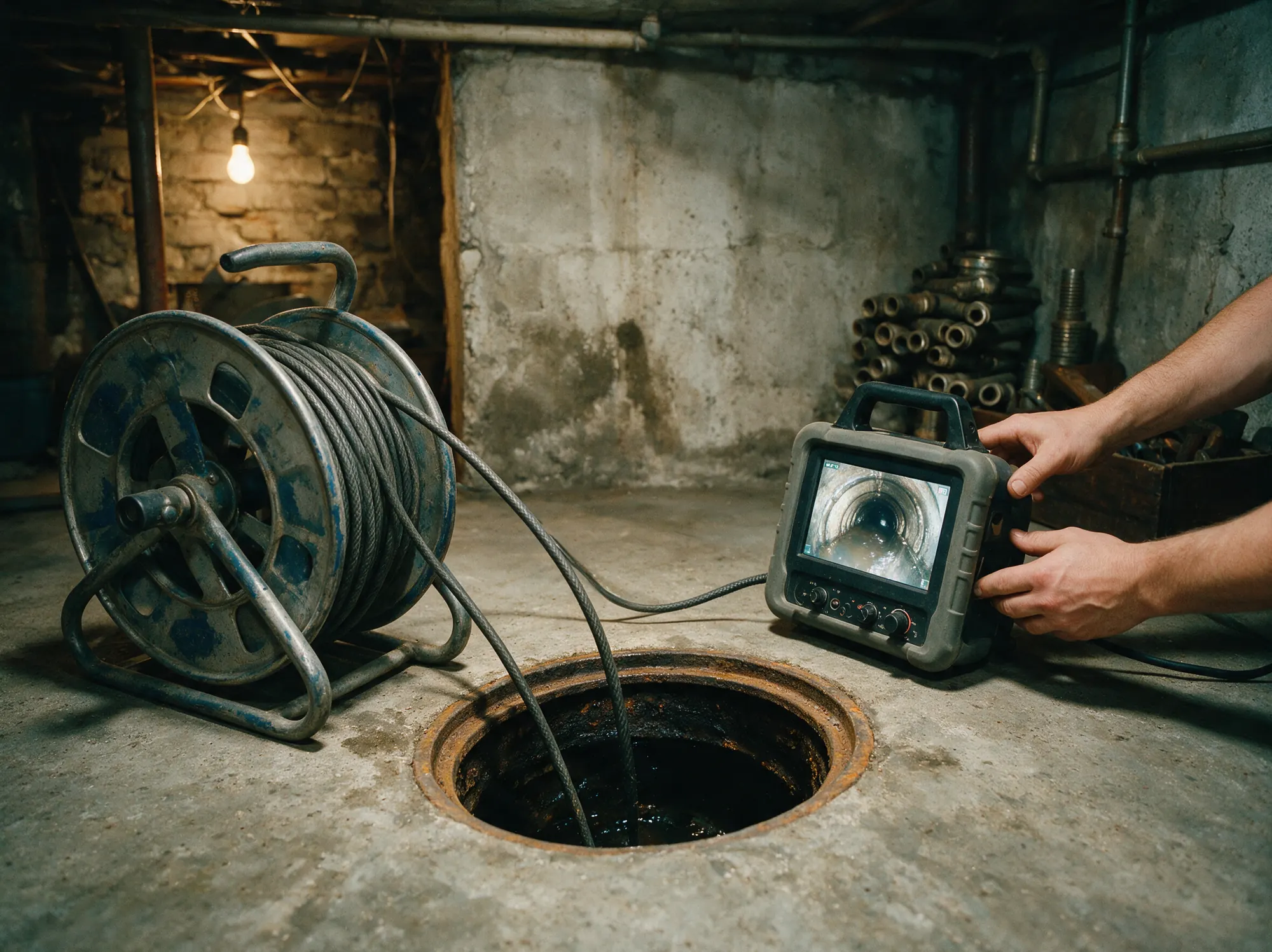
We run a camera through the line from a cleanout or an opened fitting, watch the full length on a screen, and show you exactly what’s down there. Then we tell you plainly what it needs: nothing, a cleaning, a repair, or a plan.
Why look before it fails
A sewer line doesn’t send a bill until it has already failed, and by then the choice has been made for you. Looking first turns a surprise into a decision. If the line is sound, you know it and can stop wondering. If it’s scaling up or has roots in it, that can be cleaned out now for a fraction of what a dig costs. If a section is broken, you can plan the repair for a dry week instead of a wet basement at eleven at night.
When we recommend it
Three situations, mostly. Buying a house. A home inspection stops at the foundation wall, and the sewer line is the most expensive thing an inspector never sees. We recommend a camera inspection before you close on any older house, and we’ll put what we find in plain terms you can take to the negotiation. A line that has never been updated. If your house still has its original sewer and nobody has looked inside it, it’s worth knowing where it stands. Clogs that keep coming back. A main line that needs clearing every year or two has a reason, and the camera finds it.
What we find in these houses
Most of the older houses in Millersburg, Elizabethville and Halifax went in with cast iron inside and clay tile outside. Original cast iron grows scale on the inside — a rough crust of rust that narrows the pipe and grabs everything going by until it starts causing clogs. Old clay pipe was laid in short lengths, and the joints separate over time. Roots find the gap and grow in, and once they’re established the line clogs on a schedule.
Both of those can be cleaned out preventively. Scale gets cut back with a descaling head, and roots get cut out and the joint watched. Neither one means the line is finished. What the camera tells us is which one you have, how far along it is, and whether cleaning on a schedule or a repair to the line is the sensible next step.
What you get
You see the footage with us, not a summary of it. We point out what’s scale and what’s a crack, where the roots are coming in, whether there’s a low spot holding water. Then we give you one of four answers: it needs nothing, it needs cleaning, it needs a repair in a specific place, or it needs a plan for replacement on your timeline rather than the pipe’s. If it’s the last one, we’ll say so and talk through the options.
It also settles a question a lot of homeowners never get a straight answer to: whether a sewer-line coverage rider on your homeowner’s insurance makes sense. That coverage is a small hedge on a sound line and worth a hard look on a tired one. Knowing which you have is the only honest way to decide.
- A cleanout makes the inspection quicker and every future problem on the line cheaper. If your house doesn’t have one, we can put one in.
- If the line is backing up right now, that’s a drain cleaning or main line call first; we camera it once it’s open. For the everyday causes of slow drains, read why your drains keep clogging.
- If your house pumps sewage up to the line rather than draining by gravity, the pump has its own page: sewage and septic pumps.
Our work
Sewer Camera Inspection we've done
Our own jobs, photographed as we left them.
 before
 after
Before: old cast iron drain lineAfter: cast iron replaced