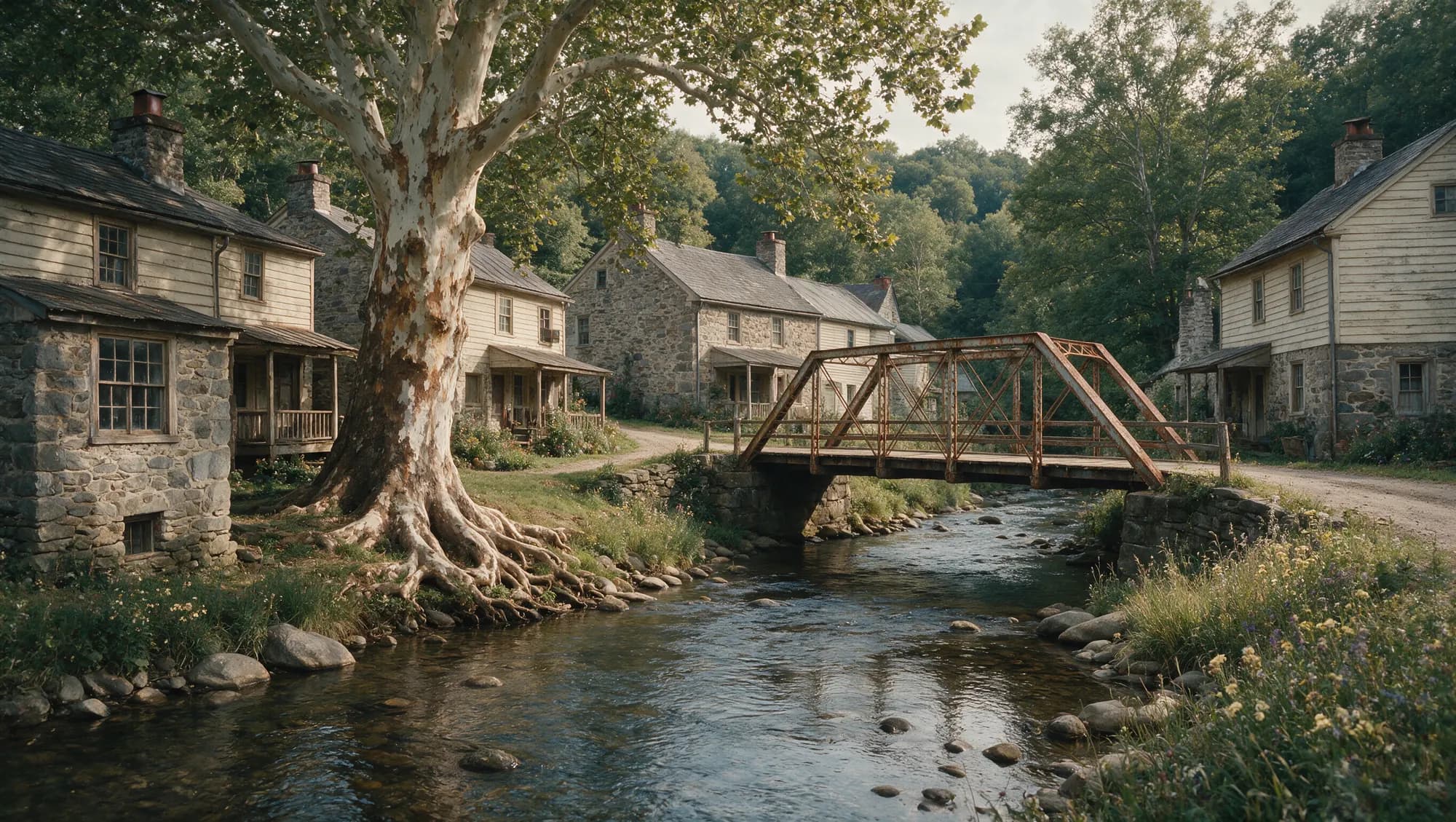
This is the oldest of the three boroughs we work in and the smallest — about a third of a square mile, 298 housing units, and more than half of them standing before 1940. It is also the only one of the three where the town water starts as spring water inside a mountain, and the only one where the sewer conversation right now is about grinder pumps.
Those two facts shape most of what we get called for. Soft mountain water is easy on a kettle and hard on copper. A borough of pre-war houses means galvanized supply, cast-iron stacks and service lines nobody has looked at in sixty years. Out in the township, 201 domestic wells are on record and roughly 143 homes have just been put on a low-pressure sewer.
The water starts inside Peters Mountain
Halifax Area Water & Sewer Authority — HAWASA — supplies the borough and part of the township. Its 2024 water quality report puts the source plainly: five mountain springs and three drilled wells, all inside the township, one behind Deppen Park and the rest near Peters Mountain Road. EPA classes the system, PWSID PA7220040, as groundwater; it serves about 2,278 people over 712 connections. Treatment is described as simple disinfectant plus softening agents, which makes it the only one of the three local systems that says it softens. Millersburg filters creek water. Elizabethville pumps wells and adjusts pH.
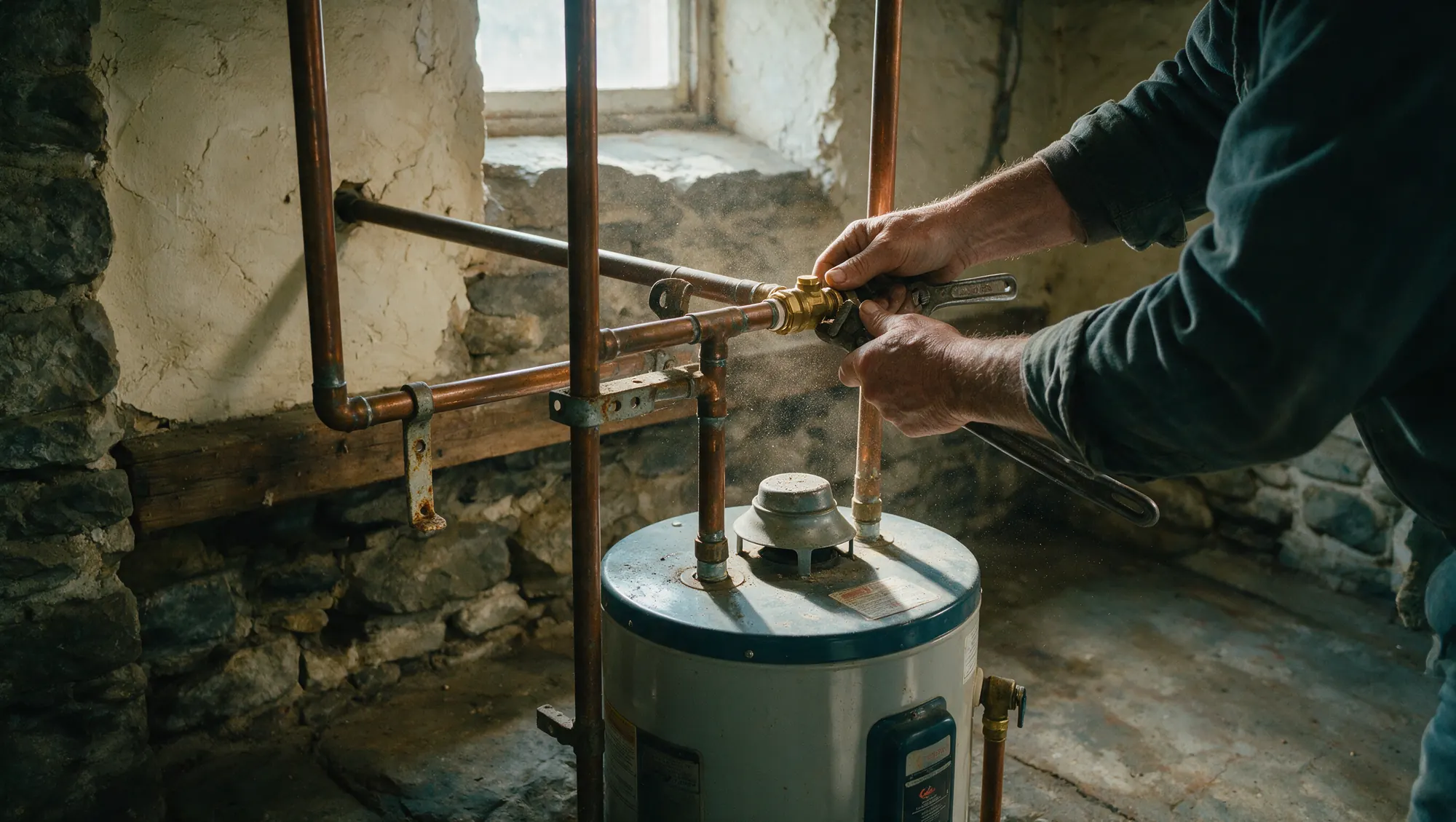
The number worth knowing here is copper. The 2024 report gives a 90th-percentile result of 1.34 ppm, with three of twenty sampled taps above the 1.3 ppm action level, and it attributes copper to corrosion of household plumbing rather than to the source. Soft, low-alkalinity mountain water is mildly aggressive toward copper tube. That shows up as blue-green staining under a dripping tap, and in older supply runs as the pinhole that stains a joist long before it makes a puddle — pipe and leak repair work, not a cleaning problem.
The same report records nitrate at 4.58 mg/L, under the 10 mg/L limit, attributed to “Runoff from fertilizer use; Leaching from septic tanks, sewage; Erosion of natural deposits.” Nitrate matters specifically for infants under six months old. With a baby in the house, or a private well in the same farmland, the next step is a test rather than a purchase.
Out in the township, the water system is yours
Halifax Township has 201 reported domestic wells — more than fifteen times the thirteen on record in Millersburg Borough, and the highest count of any municipality in our immediate area. The figure comes from the state groundwater information system by way of the county’s 2025 hazard mitigation plan, which notes that the database depends on drillers filing records voluntarily. Treat it as a floor. The borough itself does not appear in that table at all, consistent with it being served entirely by the authority.
Pennsylvania has no statewide construction standards for private water wells. Penn State Extension says the features most often missing are the two cheapest: a sanitary well cap and a grout seal around the casing. The 2007 joint comprehensive plan for this area repeats the siting rule — at least 100 feet from a septic leach field, a road, a fuel tank or a barnyard. On steep ground under the mountain, that is not always what somebody achieved in 1962. More on the well pumps page here.
Be careful with numbers here. Across wells sampled by USGS and state programs in Dauphin County, median hardness is 120 mg/L — seven grains per gallon — iron sits above the 300 µg/L staining threshold in 32%, manganese above 50 µg/L in 36%, and pH below 6.5 in 22%. Those are sampled wells across the whole county, including monitoring and research wells, in a county that also holds the anthracite belt where mine drainage depresses pH and raises iron and manganese. They say nothing about yours. Test, then talk about water treatment with a lab report in hand.
The geology gives one more clue. The 2007 plan describes the Hamilton Formation as producing “well yields that are fair but the water may have high iron and sulfur content.” That is why the rotten-egg smell turns up on some wells here and not others. No hydrogen-sulfide figures exist for these wells, so we will not quantify it.
Roughly 143 households here now own a grinder pump
The Halifax Township Sewer Extension Project, delivered by HAWASA and engineered by HRG, put approximately 143 grinder pump systems into service alongside 25,115 linear feet of low-pressure sewer main, 13,169 feet of gravity main, 9,023 feet of force main and three pumping stations. Construction ran to about $12.8 million, backed by $17,107,000 of PENNVEST funding — a $10,587,348 grant plus a $6,619,652 loan at one percent over twenty years. The corridors are portions of Peter’s Mountain Road between Creek Road and Powell’s Valley Road, along with Creek Road, Hill Drive, Million Dollar Road, Parmer Drive and Powell’s Valley Road.
It happened because the township’s 2018 Act 537 Plan designated those areas as “Needs Areas,” on the basis of “evaluation of the number of on-lot disposal system (OLDS) malfunctions, well sample results, soil suitability, and planned and projected growth.” Shallow soil over bedrock, seasonal high water and slope are hard on a drainfield.
For a household on one of those roads the change is not administrative. A septic tank in the yard worked by gravity and asked nothing of anybody. A grinder pump is a machine in a basin outside the house, wired to your panel, with an alarm, a check valve and a small-diameter pressurized discharge, and everything the house flushes now goes through a cutting impeller first. That is a category of service call this township has and Elizabethville does not; the sewer and septic lines page here covers it.
What is behind the plaster in a pre-war house
166 of the borough’s 298 housing units — 55.7% — were built in 1939 or earlier. Dauphin County’s share is 19.1% and Pennsylvania’s is 25.0%. The census median year built is bottom-coded at “1939 or earlier,” which is the survey’s way of saying the typical house here is older than the question can measure. 59.4% predate 1950 and 86.2% predate 1980. Not one unit was recorded as built in 2010 or later.
Read that as a materials list. Pre-war usually means galvanized steel supply corroding from the inside until the fixture farthest along the run has nothing left, cast-iron drainage with lead-and-oakum hub joints, and copper tied straight onto galvanized where a bathroom was modernized in the seventies. Vacancy runs at 17.1% here, much the highest of the three towns, and a house standing empty through a cold snap is the classic call for frozen and burst pipes.
The township tells a different story. Halifax Township built 403 housing units in the 1980s, which puts the polybutylene and early CPVC cohort out there rather than in town — polybutylene ran from roughly 1978 to 1995, and it is the plastic fittings that give way. The township also holds 277 mobile homes, 18.9% of its housing stock, against 2.6% countywide: supply lines in an exposed or lightly skirted underbelly, a water heater in an interior closet, and no basement for a well pressure tank.
Water that comes in from outside
The county’s 2025 hazard mitigation plan is direct about the borough: “The principal source of flooding in the Borough is the Susquehanna River. Major flooding occurred in 1886, 1936, and 1972. The flood of 1972 was the worst, with river flow downstream measuring 1,020,000 cubic feet per second.” For the township it names something else entirely: “Flooding of small tributaries from local thunderstorms typically affects Armstrong Creek, Gurdy Run, and Powells Creek.”
The chronic exposure is not where most people assume. On FEMA’s repetitive-loss list the borough carries zero properties; the township carries seven single-family repetitive-loss properties, none of them mitigated. The river gets the anniversaries; the creeks keep flooding the same handful of houses. Basements here are stone and rubble as often as poured concrete, and the county rates radon potential High, so a sump pit gets a sealed, gasketed lid and a discharge to daylight.
Winter, and the fact that there is no gas line
Not one occupied housing unit in the borough heats with natural gas. Zero of 247. Just over half the town runs on electricity and 42.1% on fuel oil; in the township fuel oil is 45.9%. So the water heater conversation here is electric or propane, tank or tankless. Never the 40-gallon natural-gas unit that is the default half an hour south across the river.
Dauphin County’s adopted design criteria put the frost line at 40 inches and the winter design temperature at 0°F. Pennsylvania’s residential code requires a water service buried at least six inches below the frost line, which makes at least 46 inches the working number here. Frost depth is set by the local jurisdiction, so confirm it with the code official before anybody digs. Anything shallower is what fails in January: an old shallow service, a line to a barn, a hose bib in a rim joist, and now a small-diameter low-pressure sewer lateral.
- Public water system
- HAWASA, PWSID PA7220040 — groundwater
- Sources
- 5 mountain springs, 3 drilled wells
- Treatment
- Disinfectant plus softening agents
- Grinder pumps, township
- Approximately 143
- Units built pre-1940
- 55.7% (166 of 298)
- Natural gas share
- 0.0% of occupied units
How we work here
This is the closest of the three towns to Harrisburg — half an hour across the river at Clarks Ferry — and many township households have somebody making that drive twice a day. In a house this old the fixture is rarely the whole story, so we look at the system. You get the repair option and the replacement option with the reasoning attached, and if the honest answer is not to spend the money yet, that is what you will hear.