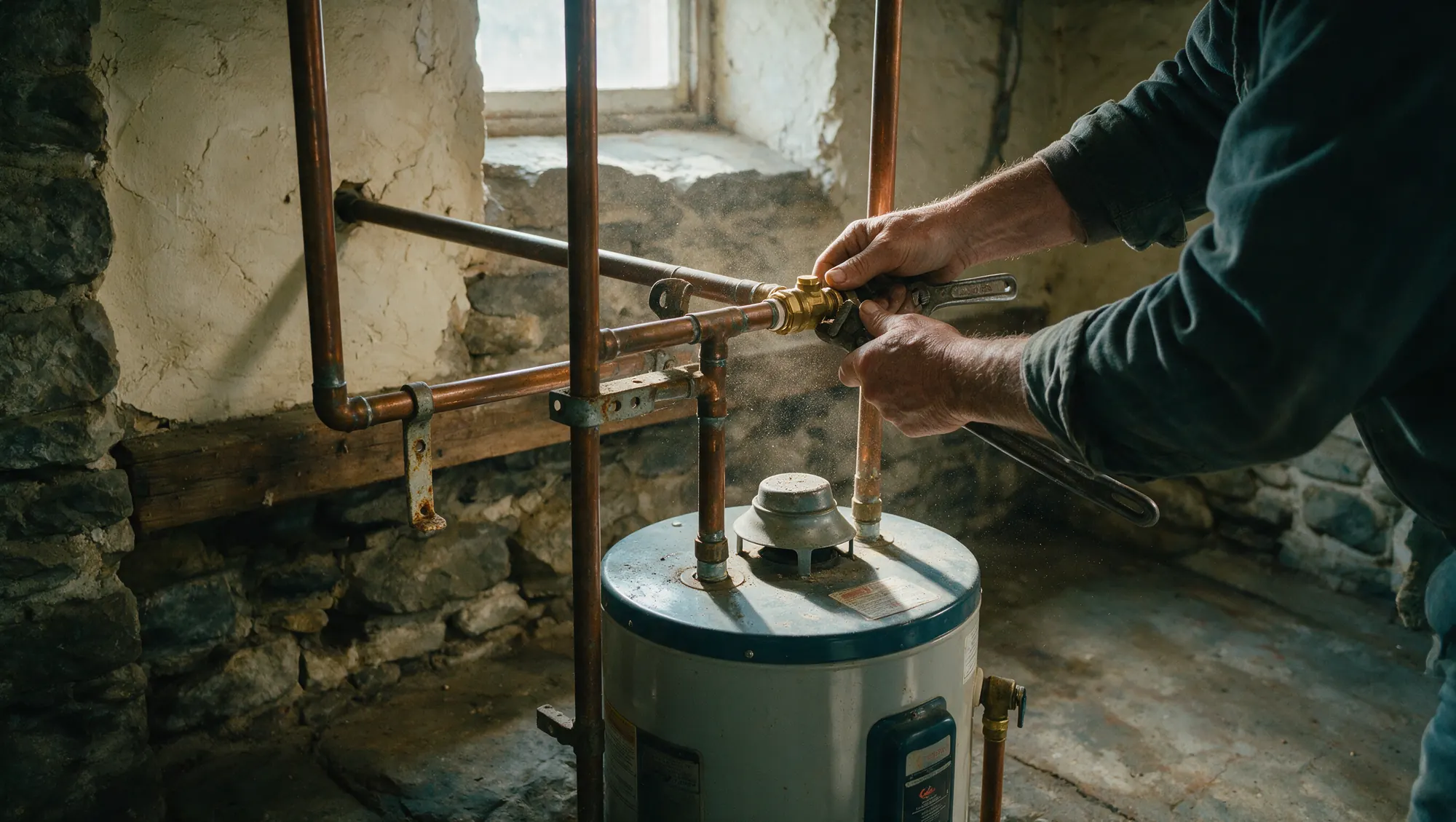
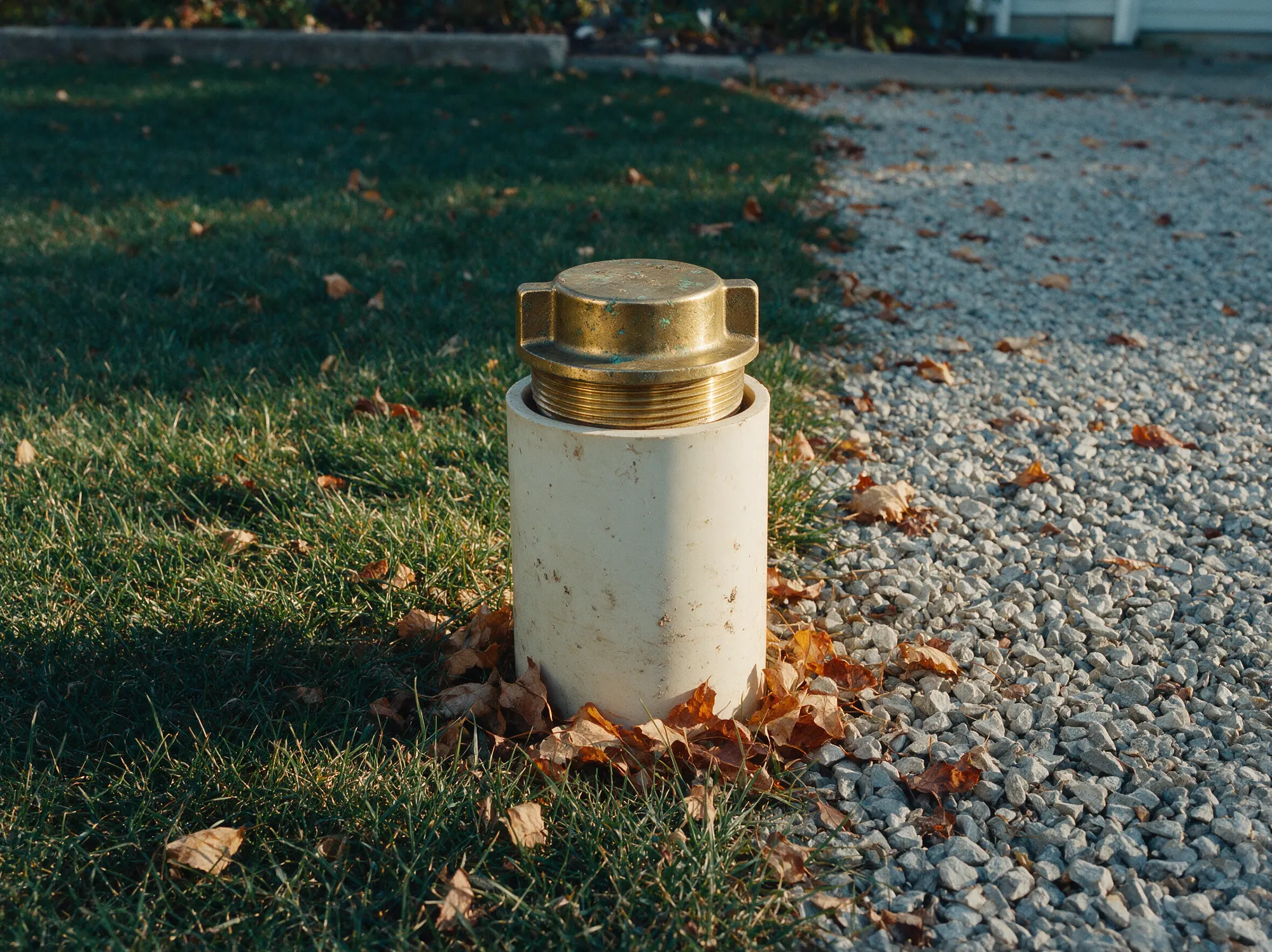
A septic tank in the yard is a patient thing. It works by gravity, it has no moving parts, and provided nobody pours paint into it, it tolerates a great deal. A grinder pump is the opposite: a machine in a basin, wired to your panel, with an alarm panel, a check valve and a small-diameter pressurized discharge line, and everything the house sends down goes through a cutting impeller before it goes anywhere.
That change is what makes drainage here different from drainage in the other towns we work in. Elizabethville has nothing comparable. Millersburg is on gravity sewer throughout. Out along Peter’s Mountain Road, Creek Road, Hill Drive, Million Dollar Road, Parmer Drive and Powell’s Valley Road, a couple of hundred households swapped a tank for a pump inside a few seasons.
Why the project happened
HAWASA delivered the extension with HRG as engineer: 13,169 linear feet of gravity main, 25,115 feet of low-pressure main, 9,023 feet of force main, three pumping stations and approximately 143 grinder pump systems serving 394 equivalent dwelling units. Construction ran about $12.8 million, funded by $17,107,000 from PENNVEST — a $10,587,348 grant and a $6,619,652 loan at one percent over twenty years.
The reason is in the township’s 2018 Act 537 Plan, which designated those corridors as “Needs Areas” following, in its own words, “evaluation of the number of on-lot disposal system (OLDS) malfunctions, well sample results, soil suitability, and planned and projected growth.” Shallow soil over bedrock, seasonal high water table and slope are hard on a drainfield. Enough systems failed to make the case for a main.
How a grinder pump actually fails
Predictably, is the short answer. There are perhaps six ways, and five of them are avoidable.
- Wipes. So-called flushable wipes do not break up, they rope. A cutting impeller shreds some of them and binds on the rest. This is the single most common grinder pump failure in the country and it will be the most common one here too.
- Grease. Cooking fat cools in the basin, coats the float switch and the impeller, and traps everything else against it. A septic tank hid this problem for decades. A pump basin will not.
- Float and alarm faults. The alarm panel is your only warning. If the light or the buzzer has been going and somebody muted it, the basin is filling right now.
- Check valve failure. The check valve stops the contents of a pressurized main flowing back into your basin. When it sticks open the pump runs repeatedly to push the same volume uphill twice.
- Freezing on the discharge. A low-pressure lateral is small-diameter, carries intermittent flow, and is often shallower than a gravity line. The frost line here is 40 inches. Anything above that is exposed on a 0°F night.
- Power outages. A grinder pump basin holds very little. No power means no pumping, and the reserve runs out faster than most people expect.
One more change worth naming: on conversion the old building sewer is disconnected and the tank taken out of service. If any part of the house still drains toward the old line — a basement fixture, a laundry standpipe, an addition plumbed separately in 1978 — it needs finding and rerouting, and it gets found the awkward way if nobody looks.
Telling a main line problem from a fixture clog
One slow sink is a fixture. More than one fixture backing up at once is the line out. The reliable test is whether the trouble follows water volume: flush a toilet and watch the tub, or run the washing machine and watch the basement floor drain. If discharging one fixture makes another one gurgle, back up or bubble, the restriction is downstream of both and it is the main.
The lowest opening in the house is where it comes out, which in a borough house is usually a basement floor drain, a basement shower or a first-floor toilet. Stop putting water in. Every load of laundry run while the main is blocked arrives on the basement floor.
On a grinder pump property the same symptom has an extra suspect: the pump itself. If the basin alarm is active and everything indoors is backing up, the block may be the pump rather than the line, and the fix is at the basin.
Cleanouts, cameras and clay
Find your cleanout before you need it. It is a capped fitting, usually four inches across, either just outside the foundation wall or at the bottom of the stack inside. In a pre-war borough house it may be buried under sixty years of grade, mulch or a deck. Knowing where it is turns a hard job into a straightforward one, and it is where a cable or a camera goes in.
A camera answers the question a cable cannot: not just that the line is clear now, but why it blocked. It shows a belly holding water, an offset joint, a crushed section, a root mass and its entry point. It will not see through standing water, so we clear first and look second.
In the borough, where more than half the housing predates 1940, the laterals are old. Vitrified clay in short sections with mortared or gasketed joints is the classic, and clay does not fail by rotting — it fails at the joints, where roots find moisture and vapor and go in. A maple or a sycamore on the verge will find a lateral from a surprising distance. Root intrusion recurs on a schedule, so the honest conversation is about cutting roots every eighteen months versus lining or replacing the run.
Where our work stops
We handle the building sewer — the line from inside the house out to the septic tank, or to the grinder pump basin, or to the municipal main. Pumping a septic tank, inspecting a drainfield, replacing a distribution box or diagnosing a saturated absorption area is septic contractor work, and it wants a septic hauler with a truck and a permit trail. If we camera a lateral and the line is fine but the tank is full to the inlet, we will say so and tell you who to call.
Sewer permits for new work in the township go through the Halifax Municipal Sewer Authority, (717) 896-3457, and the treatment process is extended aeration with secondary sand drying beds. One standing rule: a sump discharge never goes to the sanitary sewer or into a septic system. The authority makes the same point on its own site — the sanitary sewer is sealed as best it can be against rainwater, because storm flow wrecks a treatment process. General mechanics are on the sewer and septic lines page, and drain cleaning covers the fixture-level work.
The general version
This page covers what’s different about sewer & septic lines in Halifax. For how we approach the work generally — the diagnostics, the repair-or-replace reasoning, the parts — read the main page.
Sewer & Septic Lines