There is a clean split here. Inside the borough the authority supplies the water, and a pressure problem is usually a valve, a regulator or a corroded galvanized branch. Outside it, up Peter’s Mountain Road and along Powell’s Valley Road, the water comes from a well: no outage map, no borough office to call, and no neighbor who can tell you when it will be back on.
Those are reported wells: the state database depends on drillers filing records voluntarily, and the county’s hazard plan says so directly, so read the number as a floor. The borough does not appear in the table at all, which fits a town served entirely by public water.
Submersible or jet, and telling which you have
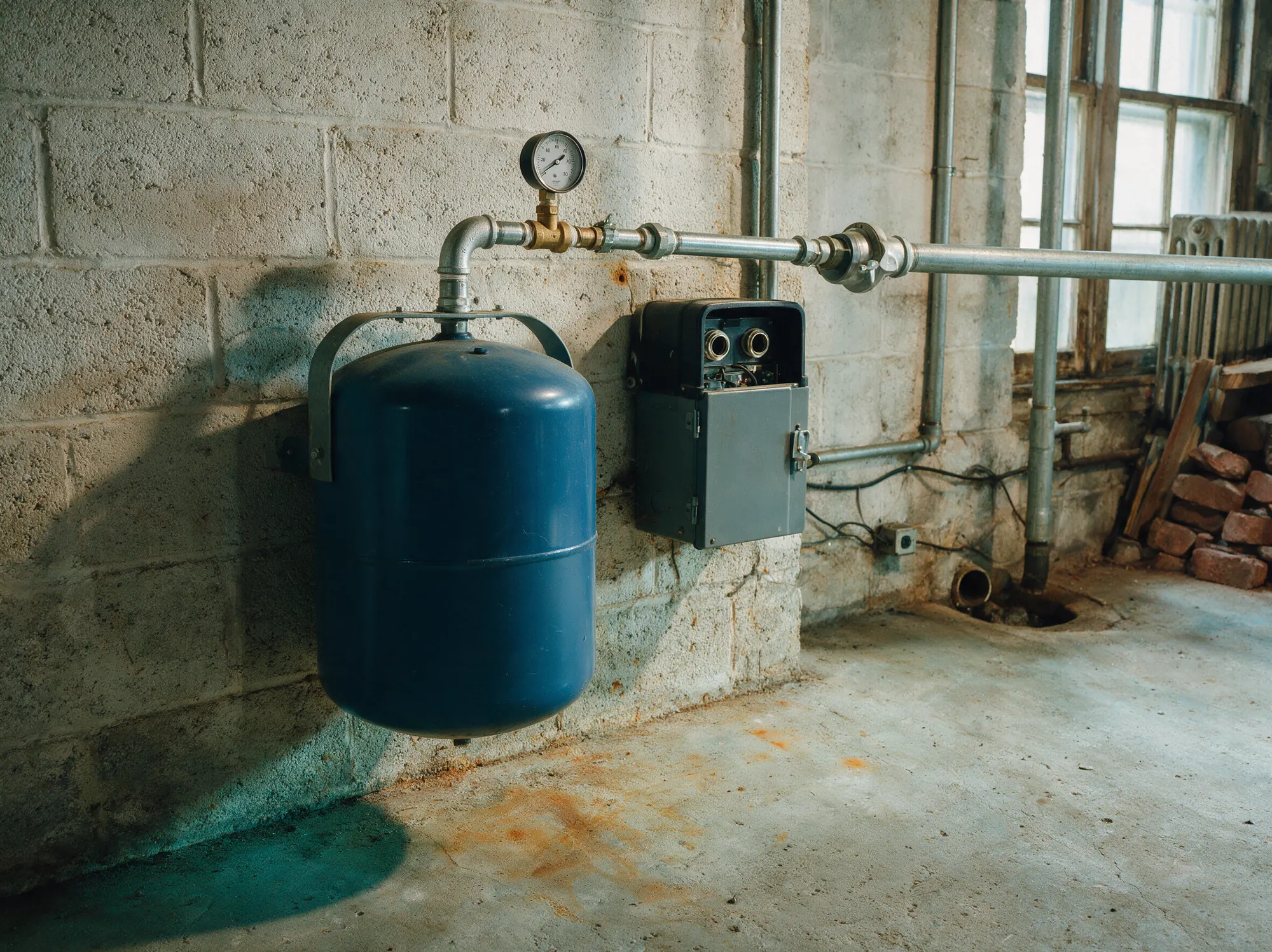
Almost every well drilled here in the last fifty years has a submersible pump: a long, narrow motor and pump assembly hanging on the drop pipe inside the casing, sometimes a couple of hundred feet down. You will not see it. What you see indoors is a pressure tank, a pressure switch and a gauge.
A jet pump sits above ground, usually beside the tank, and you can hear it. Shallow-well jets pull from about 25 feet or less; deep-well jets use two pipes and an ejector down the well. Older properties near the creek bottoms sometimes still run one. The distinction matters: a jet pump loses its prime and a submersible cannot, so “the pump runs but no water comes” means different things on the two systems.
Terrain matters too. Wells drilled into the flank of the mountain are often deep and modest-yielding; wells in the flats near Armstrong Creek and Powells Creek can be shallower but sit closer to surface influence. The 2007 joint comprehensive plan describes the Hamilton Formation as giving “well yields that are fair but the water may have high iron and sulfur content” — which is why two houses a mile apart out here behave entirely differently.
Short-cycling is the fault that destroys equipment
If the pump is clicking on and off every few seconds while a tap runs, go shut the breaker off. A submersible motor is cooled by the water moving past it and is rated for a limited number of starts per day. Short-cycling can burn one out in an afternoon, and pulling a pump from a deep well is the expensive part of the job, not the pump itself.
The usual cause is a waterlogged pressure tank. A modern tank has a rubber bladder with a cushion of compressed air behind it, and that air is what stores pressure between pump starts. When the bladder fails the tank fills with water, and the pump starts and stops on every few cups of draw. Tip the tank — if it feels full and dead rather than light at the top, that is your answer.
Reading the gauge and the switch
Most systems here are set to one of two ranges. 30/50 means the pump starts at 30 psi and stops at 50. 40/60 starts at 40 and stops at 60. Watch the gauge with a tap open: the needle should fall smoothly to the cut-in figure, the pump should start, and the needle should climb steadily to the cut-out figure and stop. Anything jerky, anything hunting around the cut-out, anything that never gets there tells you something.
The air charge in the tank should be set about 2 psi below the cut-in pressure — 28 psi on a 30/50 system, 38 psi on a 40/60. Check it at the schrader valve on top with the power off and the tank drained of pressure. If air hisses out of that valve with water behind it, the bladder has gone.
A pressure switch is a small gray box with a diaphragm and contacts, and it fails in ordinary ways: pitted contacts that will not close, a plugged sensing tube, a stiffened diaphragm. It is also the part most often replaced when the real problem was elsewhere, which is why we test before we swap.
No water at all: work it in this order
- Check the breaker and any separate pump disconnect. A tripped breaker that resets and holds is a clue, not a fix — something made it trip.
- Read the gauge. Zero means nothing is being delivered. A reading stuck above cut-in means the switch is not calling for the pump.
- Listen at the well head and the tank. A submersible is quiet, but you can usually hear the switch click.
- Check for a blown pressure tank or a closed valve before assuming the pump. Isolation valves get bumped in a crawl space.
- Consider the season. After a dry stretch a low-yielding mountain well can be running short rather than broken. The symptom is water that returns after a few hours off.
- Stop there. Pulling a pump, opening a control box or working on the wiring is not a homeowner job on a 230-volt circuit down a wet hole.
Pitless adapters, well caps and the two cheap things missing
The pitless adapter is the fitting through the side of the casing, below the frost line, that takes water sideways to the house without exposing the pipe to freezing. With a 40-inch frost line here, it should be well down. Older installations sometimes have a well pit instead — a buried chamber around the casing head — and pits flood, freeze and let surface water straight at the well.
Pennsylvania has no statewide construction standards for private wells. Penn State Extension says the two features most often missing are the sanitary well cap and the grout seal around the casing, both of which stop surface water running down the outside of the casing into your drinking water. On a property with livestock, a fuel tank or an older on-lot septic system nearby — the 2007 plan recommends 100 feet of separation from each — a vermin-proof cap with a screened vent is the best-value thing you can do to a well.
No basement to put a tank in
The township holds 277 mobile homes, 18.9% of its housing stock, against 2.6% countywide. That changes the job. There is no basement for the pressure tank, so it lives in an interior closet beside the water heater or in an outbuilding, and both have consequences: a closet has no floor drain when the tank finally weeps, and an outbuilding needs heat or the tank and switch freeze solid. Where a tank has to sit outside conditioned space, heat tape on a thermostat and insulation over the tank and switch, not just the pipe, is what gets it through a 0°F night.
The general mechanics — how tanks are sized, when a pump is worth pulling, what a well’s recovery rate means — are on the well pumps and pressure tanks page. If the water itself is the complaint rather than the pressure, start with water treatment and a test.
The general version
This page covers what’s different about well pumps & pressure tanks in Halifax. For how we approach the work generally — the diagnostics, the repair-or-replace reasoning, the parts — read the main page.
Well Pumps & Pressure Tanks