Losing water on a private well is not like losing it on a public main. Nobody at the authority can tell you when it comes back, because the equipment is yours and it is in your yard.
The state’s groundwater information system, reproduced in Dauphin County’s 2025 hazard mitigation plan, records 18 reported domestic wells in the borough and 124 in the township that wraps around it. Jackson Township has 133, Wayne 88, Mifflin 51. Those are reported wells — the database runs on voluntary driller submissions, so it is a floor, not a census.
Submersible or jet, and how to tell in ten seconds
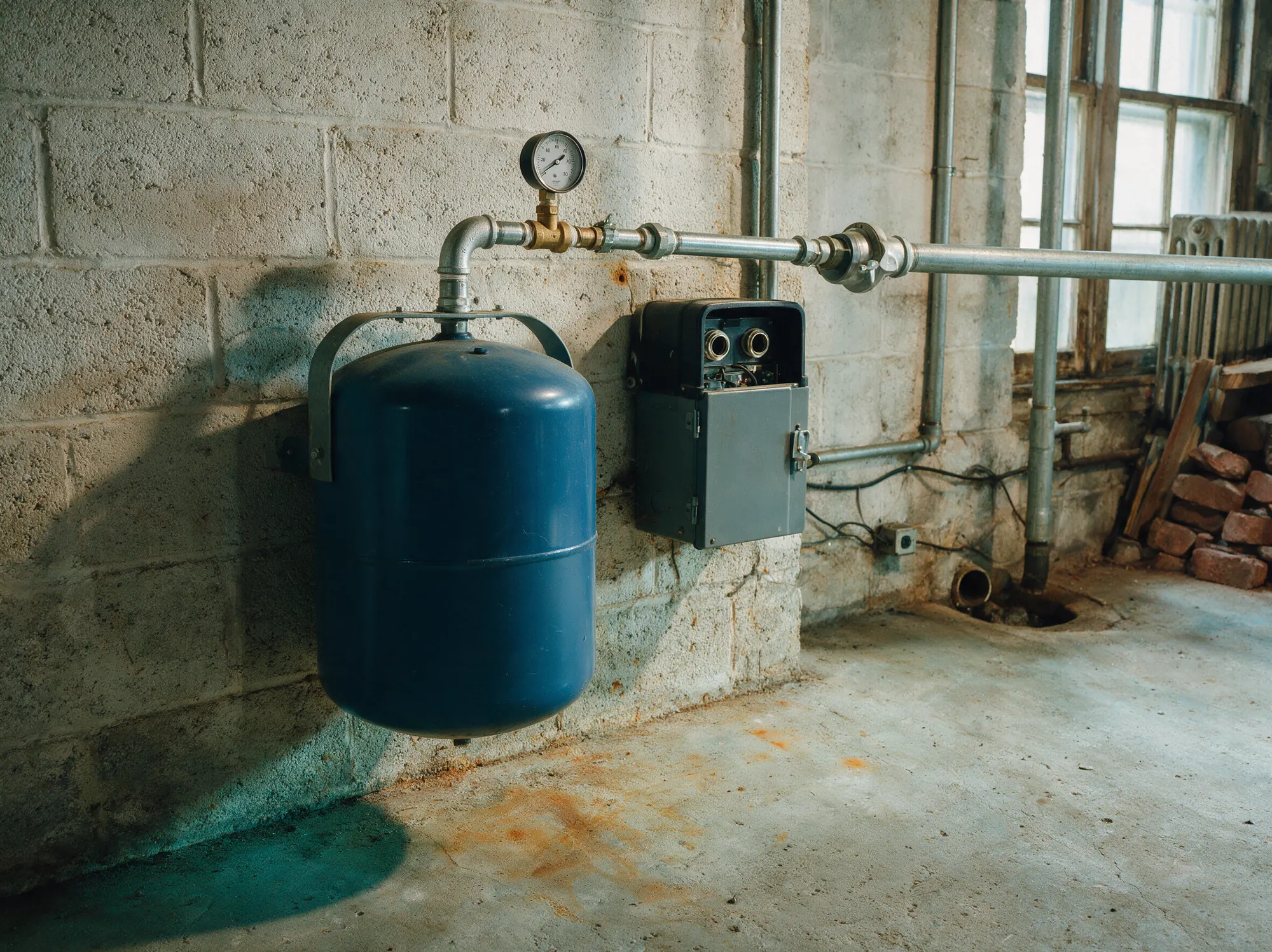
Stand where the water line enters the house. A pressure tank, a switch box and a gauge and nothing else means a submersible — a long thin motor hanging down the casing, pushing water up. A pump motor sitting in the basement or a well house, with pipes running out toward the well, is a jet pump, which pulls rather than pushes.
A shallow-well jet uses one pipe and is limited to roughly 25 feet of lift, which is why it survives mostly on older dug and driven wells; a deep-well jet uses two and goes further. Most drilled wells in this valley are on submersibles. The distinction matters: a jet can lose its prime and a submersible cannot, and troubleshooting a jet happens at eye level while a submersible may mean pulling a couple of hundred feet of drop pipe.
Short-cycling, and the breaker
If the pump clicks on and off every few seconds while a tap runs steadily, stop reading and shut the breaker off. That fault destroys pumps faster than anything else, and every minute it runs costs money.
A pump motor’s hardest moment is the instant it starts, and the pressure tank absorbs that — a cushion of compressed air, so one start delivers many gallons before pressure falls back to cut-in. Lose the charge, the tank fills with water, and the pump starts and stops on almost every gallon. A motor designed for a handful of starts an hour begins doing hundreds, and the windings and bearings fail in months instead of years.
Check the tank yourself. Knock down the side of it with a knuckle: a healthy tank rings hollow across the top and dull toward the bottom, with the change roughly a third of the way up. All dull means waterlogged. Older galvanized tanks without a bladder lose their charge routinely and need air added; a bladder tank that has lost charge usually needs replacing.
30/50, 40/60, and what the gauge is telling you
A pressure switch has two settings: where it starts the pump, and where it stops it. The standard factory pairs are 30/50 and 40/60 psi, both with a 20 psi differential. Watch the gauge with a tap running — the needle falls to cut-in, the pump starts, and it climbs to cut-out. That tells you which switch you have without taking a cover off.
People ask about moving from 30/50 to 40/60 for better shower pressure, and it is sometimes right. It is not free. The houses on these township roads carry supply pipe of the same vintage as the borough’s — galvanized, old copper, 1970s plastic — and adding 10 psi finds every marginal joint and tired hose bib in the building. The tank has to be re-charged to match: the air pre-charge sits 2 psi below cut-in, measured with the system depressurized.
The switch itself is a common failure and a cheap one. The contacts arc every time they close, and after enough cycles they pit and either weld shut or stop making. A switch that chatters, or a pump that starts when you tap the cover, has told you what it needs.
No water at all: the order to check things
- The breaker. A tripped breaker sits between on and off. Reset it once. If it trips again, stop — repeated resets into a fault damage the motor and the wiring.
- The gauge. Zero pressure with the pump not running is a different problem from 20 psi that will not climb. Write down what you see before touching anything.
- Listen. In a quiet house a submersible is a faint hum through the plumbing; a jet pump is unmistakable. Silence with a low gauge points at power, the switch or the motor. Running with no pressure rise points at a lost prime, a failed check or foot valve, a hole in the drop pipe, or a water level below the pump.
- Check the switch contacts. With the power off, a look inside the switch cover shows burnt or pitted contacts plainly. Blackened points are a switch, not a pump.
- Stop guessing after that. Beyond this point the next steps involve the wellhead, the drop pipe and live 240-volt wiring. That is where we come in.
A useful test while you wait: isolate the house at the pressure tank outlet valve and watch the gauge for an hour. If pressure falls with nothing drawing, the loss is on the well side — drop pipe, check valve, foot valve or tank. If it holds, it is in the house, which makes it a pipe and leak repair problem.
Pitless adapters, well caps and grout seals
A pitless adapter takes the discharge out through the side of the casing below the frost line, so nothing carrying water sits exposed. With the county frost line at 40 inches and a winter design temperature of 0°F, that fitting is why a wellhead survives January. A leaking one shows as a wet patch around the casing, air in the lines, or a pump running long.
The wellhead is where the cheapest problems hide. Pennsylvania is one of the few states with no statewide construction standards for private water wells, and Penn State Extension is direct about the consequence: the features most often left off are a sanitary well cap and a grout seal. A proper cap is bolted, gasketed and vented through a screened downturned vent, and sits above grade rather than in a pit that fills with runoff. A loose or cracked cap invites insects and surface water in.
That matters. About half of Pennsylvania’s private wells have never been tested, and bacterial contamination turns up in roughly half of those that are; PA DEP recommends testing at minimum annually for coliform bacteria. When we are at a wellhead anyway we look at the cap and say what we see — and if the water has a taste, a smell or a stain, that is a water treatment conversation that starts with a test. General pump, tank and switch work is on our well pumps page.
The general version
This page covers what’s different about well pumps & pressure tanks in Elizabethville. For how we approach the work generally — the diagnostics, the repair-or-replace reasoning, the parts — read the main page.
Well Pumps & Pressure Tanks