Three eras of supply pipe run through this town, and each fails in its own way. Which one you are standing under decides whether the answer is a two-hour repair or a repiping conversation.
The census numbers set the odds. 43.8% of the housing stock was built in 1939 or earlier, 48.0% predates 1950, and 93.8% predates 1980. Nine houses in the whole borough have gone up since 2000, and the ACS estimate shows none since 2010.
Galvanized steel, and the order it gives up
Zinc-coated steel was the supply standard until copper displaced it, so it runs under most of the pre-war half of this town. The zinc erodes from the inside. Once it is gone the steel rusts, and the rust forms tubercles — hard nodules that grow inward until the bore of a three-quarter-inch pipe is the diameter of a pencil.
It announces itself in a sequence you can read without opening anything:
- Brown or rust-tinted water on the first draw of the morning, clearing after ten or fifteen seconds. That is sediment that settled overnight in a pipe rusting internally.
- Weak flow at the fixture farthest from where the service enters the house, while the one nearest it is still fine. Restriction is cumulative along the run.
- The hot side noticeably worse than the cold. Hot water accelerates the whole process, so hot lines are always further along than cold lines of the same age.
- Shower pressure collapsing when somebody flushes a toilet. In an unrestricted system that is a mild dip. Through tuberculated galvanized it is a cliff.
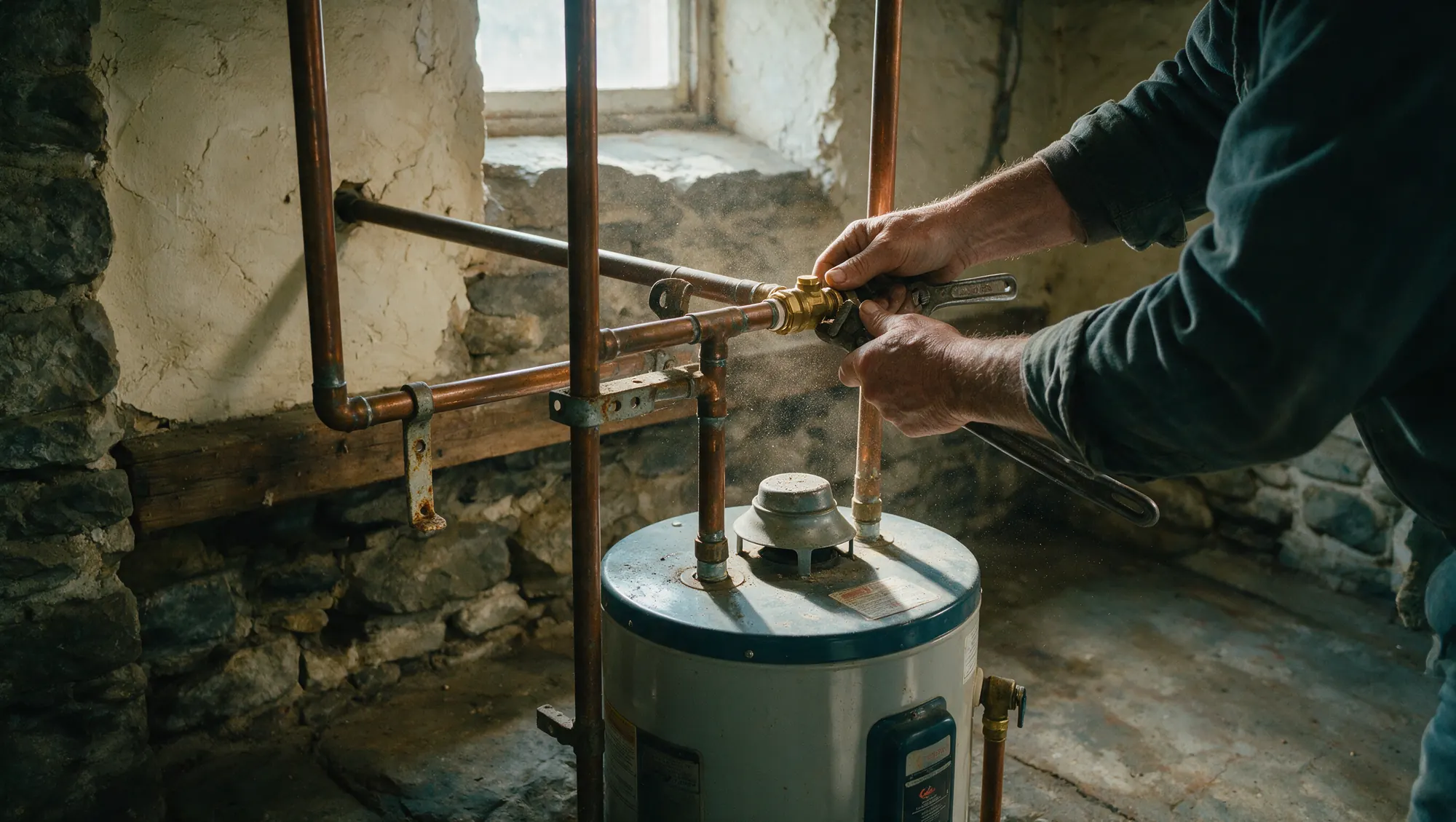
One thing to check before anybody talks about repiping: the short galvanized nipples at the water heater. They are the hottest, most restricted six inches in a lot of these basements, they close up faster than anything else, and swapping them is a small job that occasionally solves the whole complaint.
Copper, and the 1986 line
The 1986 amendments to the Safe Drinking Water Act banned lead solder and flux on plumbing connected to a public water system. With a median build year of 1951 here, and 1940 for owner-occupied houses, most of the copper in town went in decades before that. Any pre-1986 soldered joint may be lead-bearing.
That is a reason to test rather than assume — particularly in a house with old copper and young children — and a reason not to let anybody disturb a lot of old joints without telling you first.
Gray pipe: the 1970s cohort
134 housing units here were built between 1970 and 1979 — 22.9% of every house in town, landing squarely on the polybutylene era. Polybutylene ran from roughly 1978 to 1995: a flexible supply pipe, usually gray, sometimes blue or black outdoors, with a dull matte finish rather than the shine of PEX.
How to identify it in your own basement, without tools:
- Color and feel. Gray, flexible, and dull. It bends by hand in a way copper does not and it has none of the gloss of modern PEX.
- The stamp. Look along the pipe wall for PB2110. That is the polybutylene designation.
- The fittings. Plastic acetal fittings with a crimped metal ring — copper or aluminum — squeezed over the pipe. The fittings are the notorious part, not the tubing.
- Where it shows up. At the main shut-off where the service comes through the wall, at the water heater, and up through joist bays to bathrooms. It is often mixed in with copper, so finding copper in one room proves nothing about the next.
The failure mode is a fitting rather than a burst mid-run. It starts as a weep at a joint where nobody looks, and the first evidence is often a stain on a ceiling below. If you find gray pipe, walk the house and note where it runs and what sits underneath. That afternoon of mapping tells you whether it is a scheduled project or an urgent one.
Corrosive water and pinholes in copper
The Elizabethville Area Authority describes its treatment of the raw well water as “simply chemical addition for pH adjustment, corrosion control and disinfection.” A utility that names corrosion control in its own one-line summary is describing groundwater that would otherwise be mildly aggressive toward metal. On the public side that is handled. On a private well outside the service area, nobody is handling it.
Across wells sampled by USGS and state programs in Dauphin County, pH fell below 6.5 — the corrosive range — in 28 of 127 wells, about 22%. Those samples span the whole county over many years and include monitoring and research wells rather than a survey of household supplies, and the county takes in the anthracite belt where mine drainage depresses pH. It describes the region, not your water.
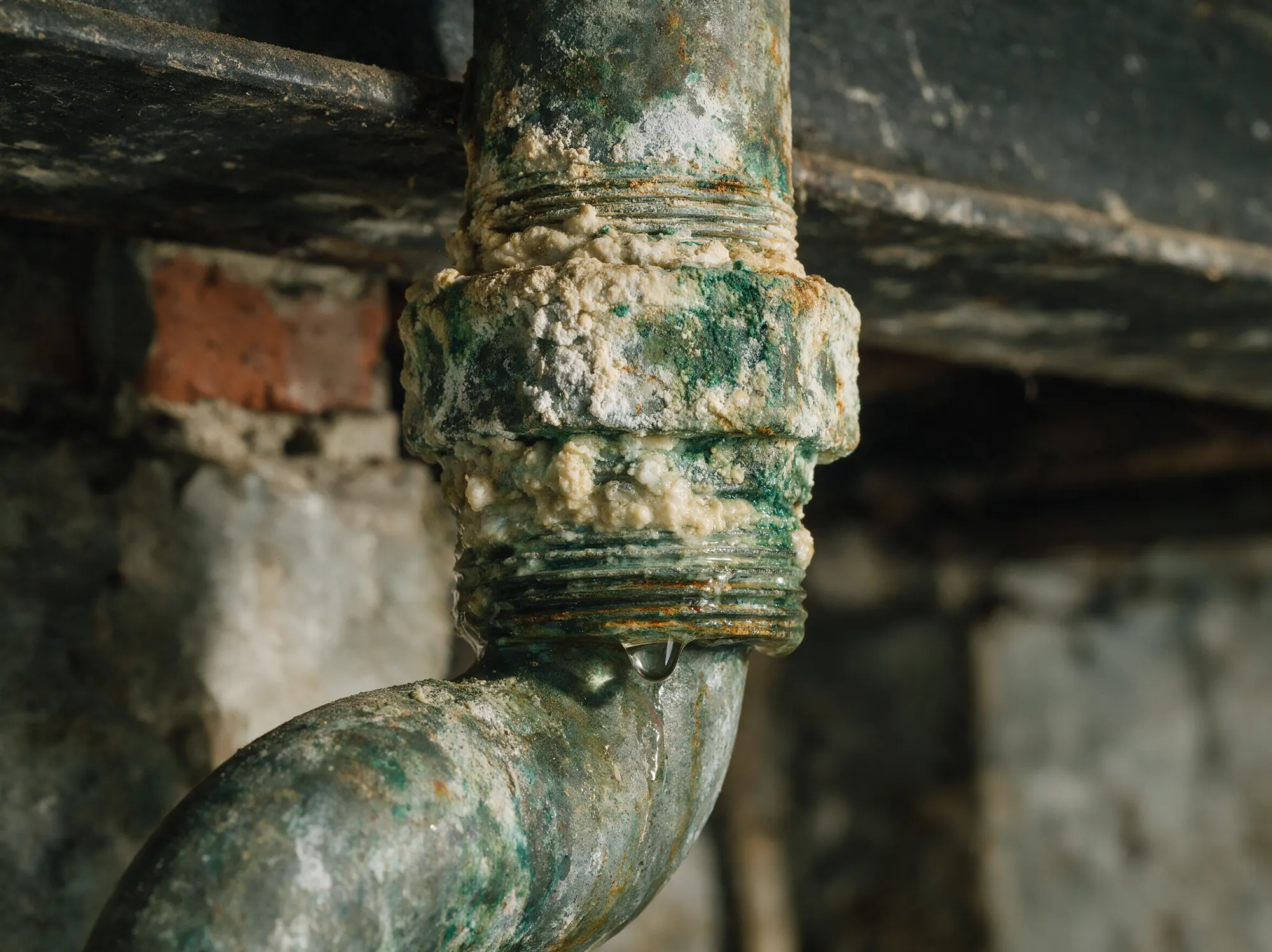
Aggressive water shows up in copper as pinholes: small round perforations in clusters rather than singly, usually on the hot side first, often on horizontal runs just past an elbow where the flow is turbulent. Blue-green staining in a tub, and green crust on the outside of a pipe, point the same way — that crust is a weep that has been evaporating for months.
When partial repiping is the better spend
Whole-house repiping is sold far more often than it is needed. Failure in these houses is rarely distributed evenly, because the houses were not plumbed all at once. A 1940 house that gained a bathroom in 1972 and a kitchen in 1998 has three vintages in it, and usually only one of them is the problem.
The rule we work to: replace what is failing, plus whatever is genuinely inaccessible while it is open. If the original galvanized trunk runs across an unfinished basement ceiling and the branches upstairs are later copper in good condition, replacing the trunk buys most of the benefit for a fraction of the disruption — and the plastered second-floor branches can wait for the year you redo that bathroom.
The honest case for doing the whole house is narrower: when leaks cluster rather than appear singly; when the walls are open for other work anyway; when the supply is polybutylene throughout, since a fitting failure anywhere is the same failure everywhere. Otherwise we will tell you where the boundary of the job should sit. The general approach to finding leaks is on our pipe and leak repair page, and if the leak turned up after a cold snap, start with frozen and burst pipes instead.
The general version
This page covers what’s different about pipe & leak repair in Elizabethville. For how we approach the work generally — the diagnostics, the repair-or-replace reasoning, the parts — read the main page.
Pipe & Leak Repair