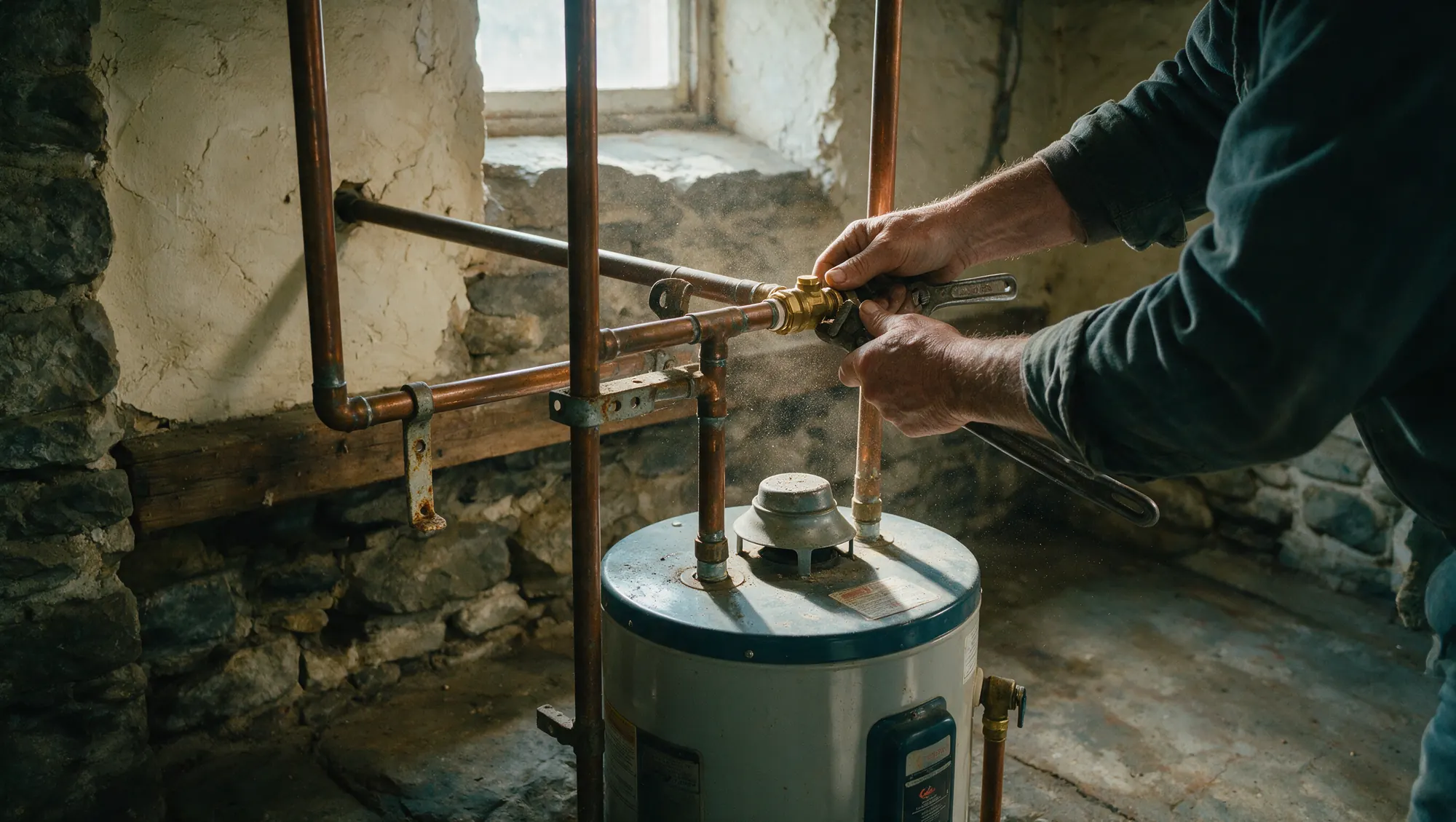
A leak is easy to describe and hard to price, because the pipe it happens in decides everything that follows it. This borough has two dominant eras. Roughly a third of the housing, 482 units, dates from 1939 or earlier, which means galvanized steel supply. The largest single block, 263 units, went up in the 1950s, which means copper joined with 50/50 tin-lead solder. Between them they account for most of the metal in town.
The general treatment of finding and fixing leaks is on our pipe and leak repair page. What follows is how it plays out on this housing stock and this particular water.
Recognizing failing galvanized
Galvanized pipe is steel with a zinc coating. The zinc goes first, from the inside, and once bare steel meets water it grows iron oxide tubercles that narrow the bore. The pipe rarely announces this with a leak. It announces it with flow, in a sequence most homeowners can read for themselves:
- Brown or rusty water on the first draw in the morning, clearing after ten or fifteen seconds. That is oxide that broke loose overnight while the water sat still.
- Weak flow at the farthest fixture — the third-floor bathroom, the end of the longest run — while the fixture nearest the meter still seems fine.
- The hot side worse than the cold. Heat accelerates the process, and the galvanized nipples at the top of a water heater are a classic hidden restriction nobody thinks to check.
- Pressure collapsing when a second fixture opens. A shower that dies when a toilet is flushed is a bore problem, not a valve problem.
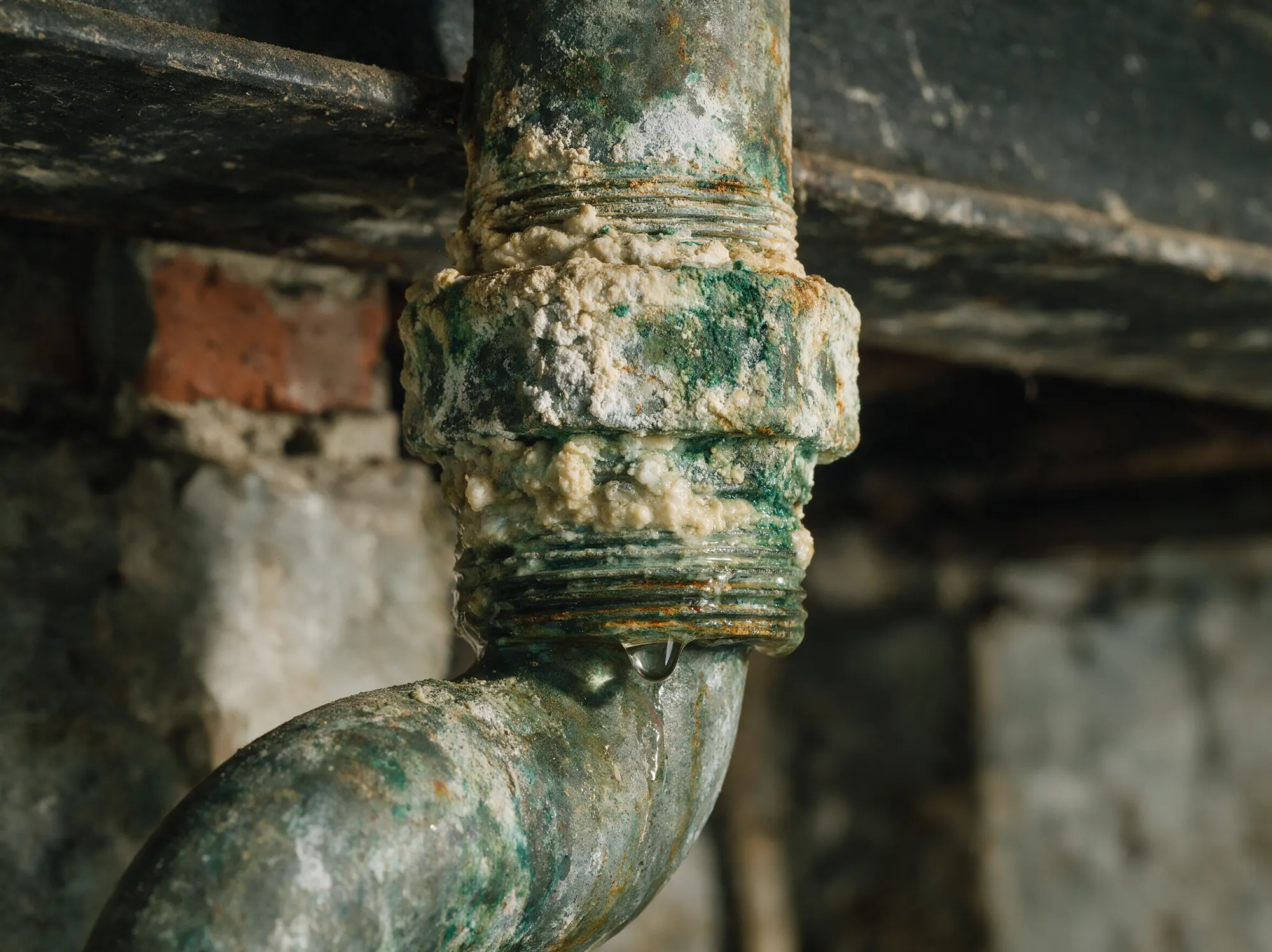
- Leaks at threaded joints rather than mid-run. Galvanized corrodes worst where the pipe was cut and threaded, because threading it removed the zinc.
Three or four of those together, and replacing one leaking section is money spent on the shortest-lived part of the job. That is the point where we would rather talk about replacing a run than patching a foot of it and coming back in March.
The 1950s block and the solder question
Copper installed in the middle of the last century was joined with 50/50 tin-lead solder. The 1986 amendments to the Safe Drinking Water Act banned lead solder in plumbing connected to a public system, which makes 1986 the dividing line: any copper joint older than that may be lead-soldered. Given that the borough’s median build year is 1953 and 81.8 percent of the stock predates 1980, that covers most of the copper in town.
That is not by itself a reason to repipe a house. EPA’s lead and copper sampling records for this system show recent ninetieth-percentile lead results far below the fifteen parts per billion action level. But those results describe the system, not your house. The utility samples a rotating set of taps, and a 1920s house on this street can still hold a lead-soldered joint or a lead closet bend inside a wall regardless of what the system-wide figure says.
What it changes in practice is how we work. When a wall is already open and pipe is already being replaced, we replace the joints rather than reuse them, and we tell you which parts of the house are pre-1986 so you are not guessing about the rest.
Where copper meets galvanized
The most common leak in a house of this age is not in either material. It is at the junction between them. Somebody remodeled a bathroom in 1998 and tied new copper into the original galvanized. Two dissimilar metals sharing water make a small battery, and the less noble metal — the steel — gives up material at the joint. The connection weeps, then swells with corrosion product, then fails.
A dielectric union or a proper brass transition is what belongs there. What is often actually there is a copper male adapter screwed straight into a galvanized coupling. It is worth finding every such junction in a house while you are already chasing one leak, because they tend to be the same age and the product of the same afternoon’s shortcut.
Filtered surface water is a different chemistry
This matters for pipe, and it is the one thing about this town that genuinely differs from the boroughs east and south. The supply here is surface water — a creek intake, springs and wells — run through a full filtration plant with corrosion control applied to the finished water. Corrosion control is a chemical adjustment made so treated water forms a protective film inside pipe rather than dissolving metal off it. The groundwater systems nearby treat for different things.
What utility-side chemistry does not do is fix a galvanic couple inside your walls, restore a galvanized main that is already tuberculated, or protect a fitting that was installed wrong in the first place. Those are two separate problems with two separate owners, and only one of them is anybody’s to solve on your property.
Rental stock, and the fixture nobody uses
Owner-occupancy in the borough runs 51.2 percent, the lowest of the three towns we cover. That produces a recognizable pattern: apartments and rented halves of twin houses where a fixture has gone a year without use, a shut-off valve that has not been turned since the day it went in, and a landlord who needs a straight answer about whether this is a repair or the opening move of a repipe.
For that situation the meter test is the cheapest diagnostic available. Close everything, note the meter reading, leave it an hour with nothing running, then read it again. Movement means water is leaving the system somewhere. It does not tell you where, but it tells you whether to keep looking, and it costs nothing.
When part of a house is enough
Repiping a whole house is rarely the right first answer. Far more often one riser, one horizontal run across a basement, or the last twenty feet feeding an upstairs bathroom is doing all the damage. We would rather map what you have, replace the section that is actually failing, and tell you plainly what the rest of it looks like, than sell a whole building on the strength of one wet ceiling.
The general version
This page covers what’s different about pipe & leak repair in Millersburg. For how we approach the work generally — the diagnostics, the repair-or-replace reasoning, the parts — read the main page.
Pipe & Leak Repair