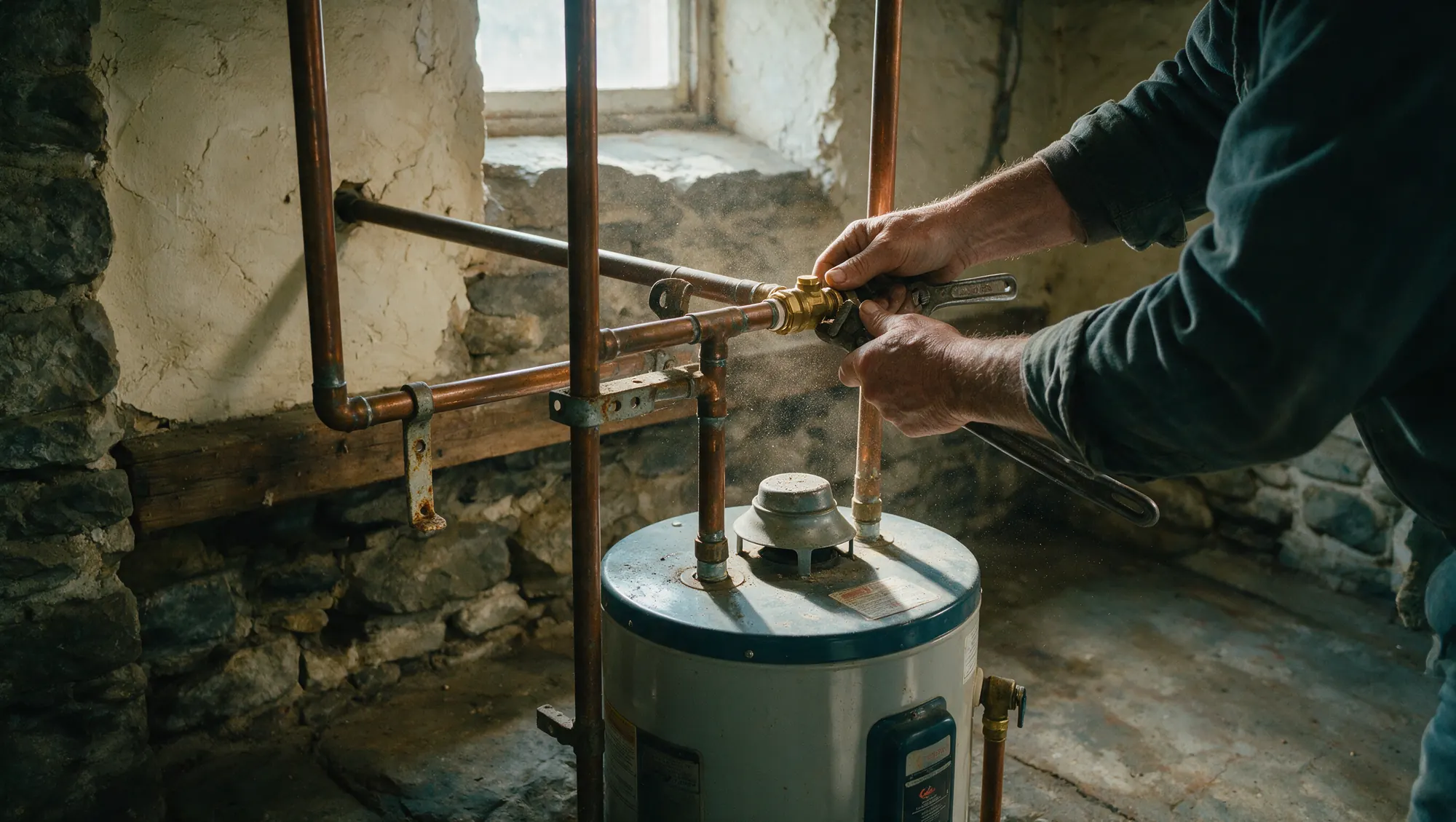
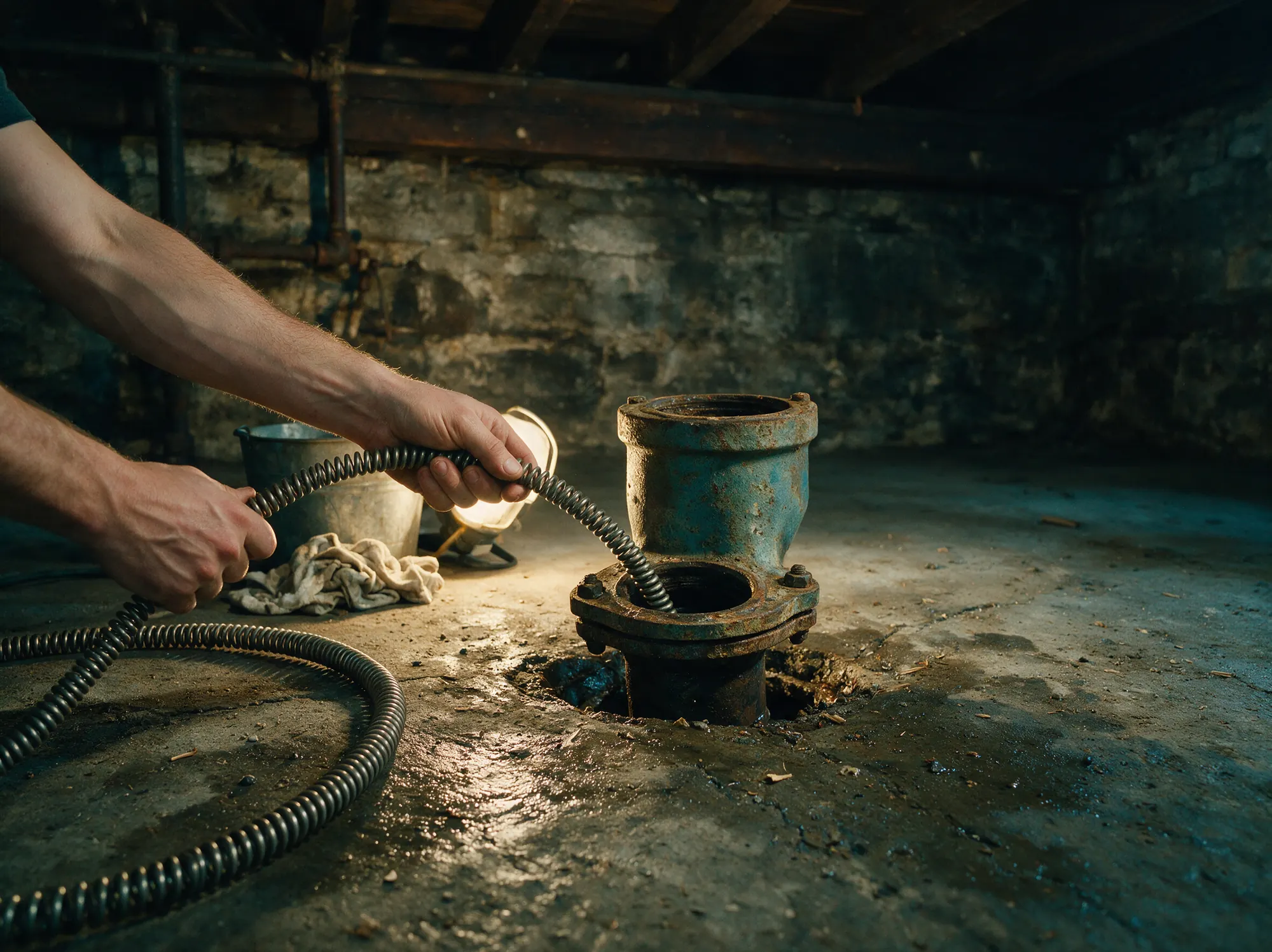
The whole of Millersburg Borough is on public sewer, treated at the Millersburg Area Authority plant and discharged to the Susquehanna. That removes an entire category of problem: nobody in town is pumping a tank or nursing a drainfield through a wet spring. What it leaves is the run of pipe between your fixture and the street main, and in a borough where 37.5 percent of the housing predates 1940 that run has some history in it.
The general approach — cabling versus jetting, camera work, why chemical openers are a bad trade — lives on our drain cleaning page. This is about the specific pipe you meet in these houses.
Cast iron, and what eighty years does to it
The building drain in a pre-war house here is cast iron, and cast iron does not fail evenly. It rusts from the invert up. The top half of the pipe can look entirely serviceable while the bottom has corroded into a rough trough that snags paper and grease on every pass. From the cleanout that reads as a clog. It is not a clog; it is a pipe that has lost its bore.
The tell is repetition. A line that clears easily and then blocks again in six weeks, in the same place, is not being cleaned hard enough — it is telling you that the pipe itself is the problem. A camera run settles the question in ten minutes and stops you paying for the same cabling four times a year, which is the outcome we would rather you got.
Lead-and-oakum joints, and why we go carefully
Cast iron of that era is joined hub-and-spigot: oakum packed into the hub, then molten lead poured over it and caulked tight. Those joints are surprisingly durable and completely unforgiving of movement. Levering on a stack to force a cable around a bend, or leaving a horizontal run hanging on one strap while working under it, can break a joint that has been watertight since 1928.
Transitions matter for the same reason. Where somebody cut into original cast iron to add a bathroom, the coupling at that junction is worth a look. A shielded no-hub coupling on a squarely cut pipe is fine and will outlast us. A rubber boot and two hose clamps carrying an offset is a future callout with a date on it.
Drum traps and S-traps
Bathrooms of the 1920s and 1930s used a drum trap: a cylindrical canister set in the floor beside the tub, with a screw lid finished flush to the tile and sometimes buried under a later floor. It holds a large volume of water and it collects hair and soap in a way a modern P-trap does not. If one tub in an old house is chronically slow while everything else runs fine, start by looking for a lid in the floor.
S-traps are the other survivor: a trap that turns straight down into the floor with no vent above it. They siphon themselves dry, which is how you get a sewer smell from a fixture that is not blocked at all. Neither one is cause for alarm. Both are worth knowing about before somebody runs a cable into the line and wonders why it will not turn the corner.
The lateral out to the street
The lateral is the pipe running from the building drain out under the sidewalk to the borough main. In housing this old it is frequently clay tile in short sections with a joint every two or three feet, and every one of those joints is somewhere a root can find moisture. This is a town of mature street trees and narrow front yards, which puts roots and pipe closer together than either would choose.
Root intrusion has a signature. A main-line backup that arrives in autumn, clears with cabling, and comes back the following year. Cutting the roots out restores flow for a season. It does not fix the joint that let them in, and we will say that rather than sell you the same visit every October for a decade.
Where the cleanout usually is
In these houses it is normally one of three places: a plug at the base of the main stack in the basement, a Y-fitting on the building drain a few feet before it leaves the wall, or an outside cleanout in the front yard where somebody has done later work. Nearly a quarter of the borough’s housing is attached or twin, and in those the basement is often the only practical access — there is no side yard to work from and the front runs sidewalk to curb.
If you can find and photograph the cleanout before we arrive, it saves real time on the visit. If you cannot find one anywhere, that is useful information too. Adding a properly placed cleanout is often the most valuable thing done on a first call, because it changes every future visit to that house.
Before you call
- Note whether it is one fixture or all of them. A single slow sink is a branch problem. Every fixture backing up, with the lowest one going first, points at the building drain or the lateral.
- Skip the drain opener. Caustic product that fails to move a clog sits in a low spot in old cast iron and keeps working on the pipe, and it makes the line hazardous for whoever opens it next.
- Stop running water. Dishwasher, washing machine, upstairs bath. A main-line blockage finds the lowest opening in the house, and in these basements that is a floor drain.
- Notice the weather. A backup that tracks with heavy rain suggests groundwater is entering the drainage somewhere, which is a different conversation and sometimes a sump one.
The general version
This page covers what’s different about drain cleaning in Millersburg. For how we approach the work generally — the diagnostics, the repair-or-replace reasoning, the parts — read the main page.
Drain Cleaning