Nobody should sell you water treatment equipment based on a description of a smell. Everything below is meant to get you to a test result, because that is the only thing that tells you which of these problems you have.
There are two audiences in this zip code. On the public system the Elizabethville Area Authority describes its treatment as “simply chemical addition for pH adjustment, corrosion control and disinfection” — done before the water reaches you. On your own well outside the service area, none of it is.
What sampled wells in Dauphin County actually contain
Wells sampled by USGS and state programs across Dauphin County give a median hardness of 120 mg/L as calcium carbonate — 7.0 grains per gallon. The 75th percentile is 166 mg/L (9.7 grains), the 90th is 227 mg/L (13.3 grains), and the maximum 310 mg/L, or 18.1 grains. 45% came in above 120 mg/L and 20% above 180 mg/L, the threshold usually labeled “very hard”.
Iron exceeded the 300 microgram-per-liter staining threshold in 32% of sampled wells. Manganese exceeded 50 micrograms per liter in 36%. And pH fell below 6.5, the corrosive range, in 28 of 127 wells — roughly one in five.
Hardness at seven grains
Seven grains per gallon sits squarely in the range where a softener is a reasonable investment rather than a luxury, and the upper quarter of sampled wells is near ten. Hardness is dissolved calcium and magnesium; it precipitates as scale wherever water gets hot or evaporates.
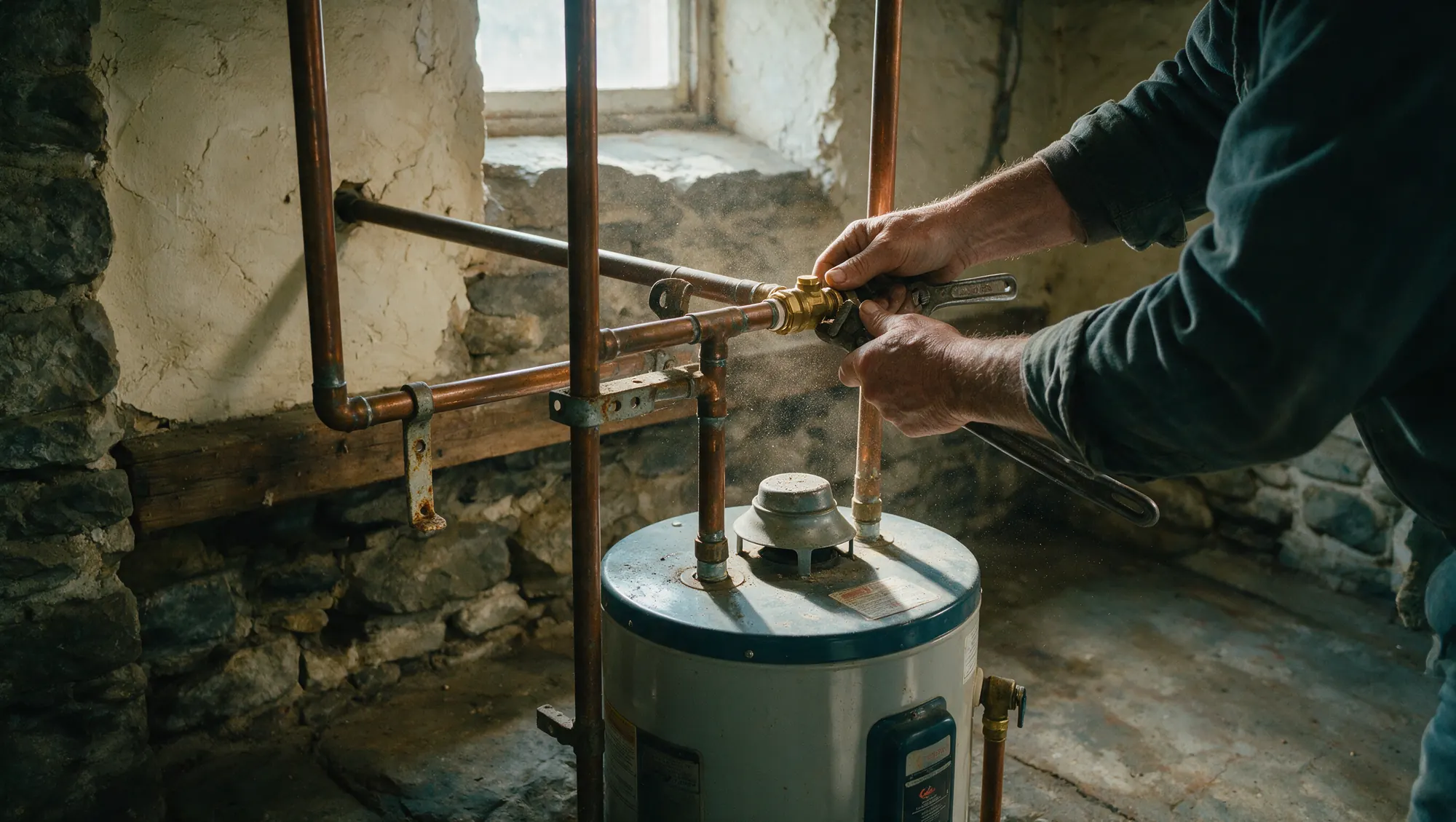
The expensive version is inside heating equipment. Scale inside a tank heater insulates the steel from the burner, so it works harder and runs hotter. Inside a tankless heater it coats the heat exchanger, and the unit throttles back or starts throwing error codes. The cheap versions are spotting on glassware, soap that will not lather and cartridges that wear out early.
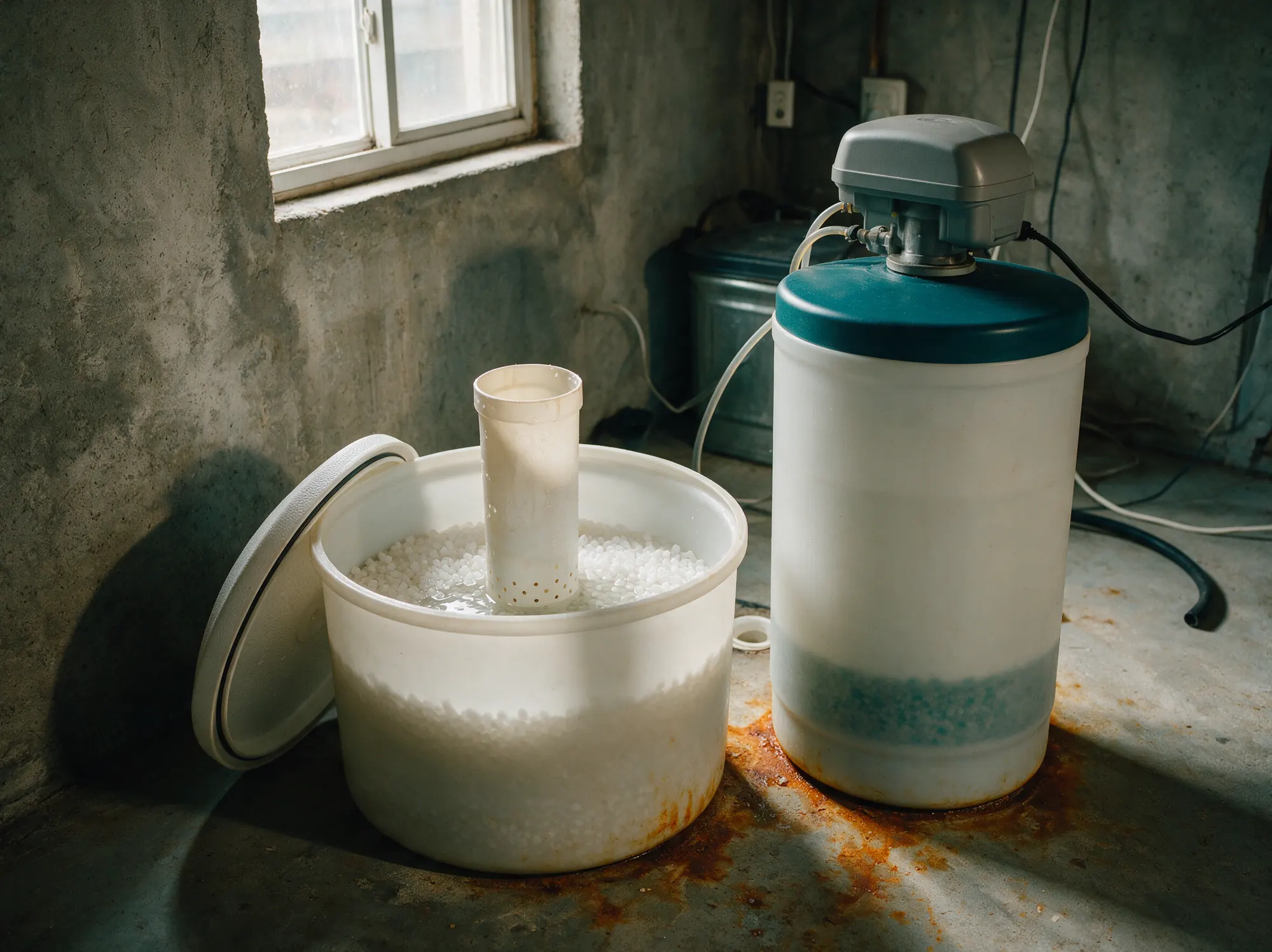
Sizing a softener needs a hardness number and an iron number, because iron consumes softener capacity and fouls the resin. Anyone who sizes one without both is guessing.
Orange and black: iron and manganese
Iron above roughly 0.3 mg/L puts the orange in a tub, the rust ring in a toilet tank and the stain in white laundry. A softener handles modest amounts of dissolved iron — the clear kind, which leaves the tap looking fine and turns orange in the bucket twenty minutes later. It will not handle iron that has already oxidized, and too much of it fouls the resin. Oxidized iron wants filtration ahead of the softener.
Manganese is the one people misdiagnose. Above about 0.05 mg/L it leaves black or dark gray staining, and a black slime in toilet cisterns that homeowners take for mold. It is harder to remove than iron and needs a higher pH to oxidize, so a system specified only for iron often leaves it untouched. If the staining is black rather than orange, say so — it changes the equipment.
The sulfur smell, and the one test that settles it
The geology gives the problem a plausible home. The Millersburg and Upper Paxton joint comprehensive plan, adopted in 2007, describes the Hamilton Formation as giving “well yields that are fair but the water may have high iron and sulfur content”. The same plan rates the Catskill Formation’s Sherman Creek Member “good to excellent” for yield and quality, and Trimmers Rock as fair but “may be high in dissolved solids”. Which one you are drilled into makes a real difference.
Before spending anything on the well, do this. Run a cold tap in a room away from the water heater for a minute and smell it. Then run the hot tap in the same room.
- Rotten eggs on both hot and cold — the source is the water supply. That is a whole-house problem, and a treatment conversation.
- Rotten eggs on the hot side only — the source is almost certainly your water heater, not your well. Sulfur-reducing bacteria react with the magnesium sacrificial anode inside the tank and generate the smell in place. Changing to an aluminum-zinc anode usually ends it — a water heater job costing a fraction of a treatment system.
Plenty of people in this county have paid to treat a well that was never the problem. Two minutes at a tap prevents it.
Acidic water, and why it matters more here
Water below about pH 6.5 is aggressive toward metal. It dissolves copper from the inside, which shows as blue-green staining in tubs, green crust where a weep has been evaporating, and eventually clusters of pinhole leaks. It eats out brass fittings and valve seats. It is the most destructive water condition there is for old plumbing, and it is what the borough’s own authority treats for.
On a private well the two usual remedies are an acid neutralizing filter — a tank of calcite, sometimes blended with magnesia, that the water dissolves a little of on its way through — or a soda ash feed pump. Both work. The neutralizer carries a consequence: dissolving calcite adds hardness. Water that was soft and acidic comes out neutral and harder, which may mean a softener you did not previously need. The order is fixed — neutralizer first, softener second.
What to test for before you buy anything
PA DEP recommends testing a private well at minimum annually for coliform bacteria, and Penn State Extension is the standard referral for a water test here. About half of Pennsylvania’s wells have never been tested at all.
- Total coliform and E. coli — the annual baseline, and the only one with a health answer attached rather than an equipment answer.
- Total hardness, in grains per gallon or mg/L — sizes a softener and explains scale.
- pH — decides whether a neutralizer belongs ahead of everything else.
- Iron and manganese, separately — orange and black are different problems with different equipment.
- Nitrate — the agricultural signature in a farming valley. It matters most for infants under six months.
- Total dissolved solids, and sulfate if the smell is on both hot and cold.
- Lead, if the house is pre-1986 with soldered copper — which describes most of the housing in this borough.
Sample from a cold tap ahead of any existing treatment equipment, and follow the laboratory’s bottle instructions exactly — a bacteria sample taken carelessly tells you about your hands rather than your well. Bring us the result and we will say what it does and does not justify buying. Our general water treatment page covers the equipment, and if pressure or sediment changed at the same time as the taste, rule out the well pump first.
The general version
This page covers what’s different about water treatment in Elizabethville. For how we approach the work generally — the diagnostics, the repair-or-replace reasoning, the parts — read the main page.
Water Treatment