A sump pump is the only machine in a house nobody looks at until the minute it has to work. It sits in a hole in a dark floor for months. Then three inches of rain lands on frozen ground, or a summer cell parks over the ridge, and everything depends on a float switch that last moved in October.
Where that water comes from here is worth understanding, because the borough and the township have almost opposite problems and the equipment answer is not the same.
Two different kinds of flooding
The county’s 2025 hazard mitigation plan puts the borough’s case simply: “The principal source of flooding in the Borough is the Susquehanna River. Major flooding occurred in 1886, 1936, and 1972. The flood of 1972 was the worst, with river flow downstream measuring 1,020,000 cubic feet per second.” That is the record peak in a Susquehanna gauge record reaching back to 1865, and it is a generational event rather than a seasonal one.
For the township the same plan describes something else entirely: “Flooding of small tributaries from local thunderstorms typically affects Armstrong Creek, Gurdy Run, and Powells Creek.” That is the flooding that actually happens, in July, from a storm that never made the regional news.
The repetitive-loss figures make the point better than anything we could write. On FEMA’s November 2023 list the borough carries zero repetitive-loss properties. Halifax Township carries seven single-family repetitive-loss properties, none of them mitigated. The river gets the anniversaries; the creeks quietly keep flooding the same handful of houses.
One clarification, because it comes up: there are USGS sites on Armstrong Creek at the town and on Powell Creek near Enterline, but they are water-quality and monitoring stations, not flood gauges with a long peak record. Do not plan around a reading that was never meant to serve that purpose.
What a stone foundation does
166 of the borough’s 298 housing units — 55.7% — were built in 1939 or earlier, against 19.1% for Dauphin County. Practically all of those sit on stone or rubble foundations, sometimes with a poured slab added later, sometimes with a dirt floor still under part of the footprint. Stone laid up with lime mortar does not resist hydrostatic pressure. It slows water down. Given a wet spring it seeps at the joints, wicks up the wall, and finds the low corner.
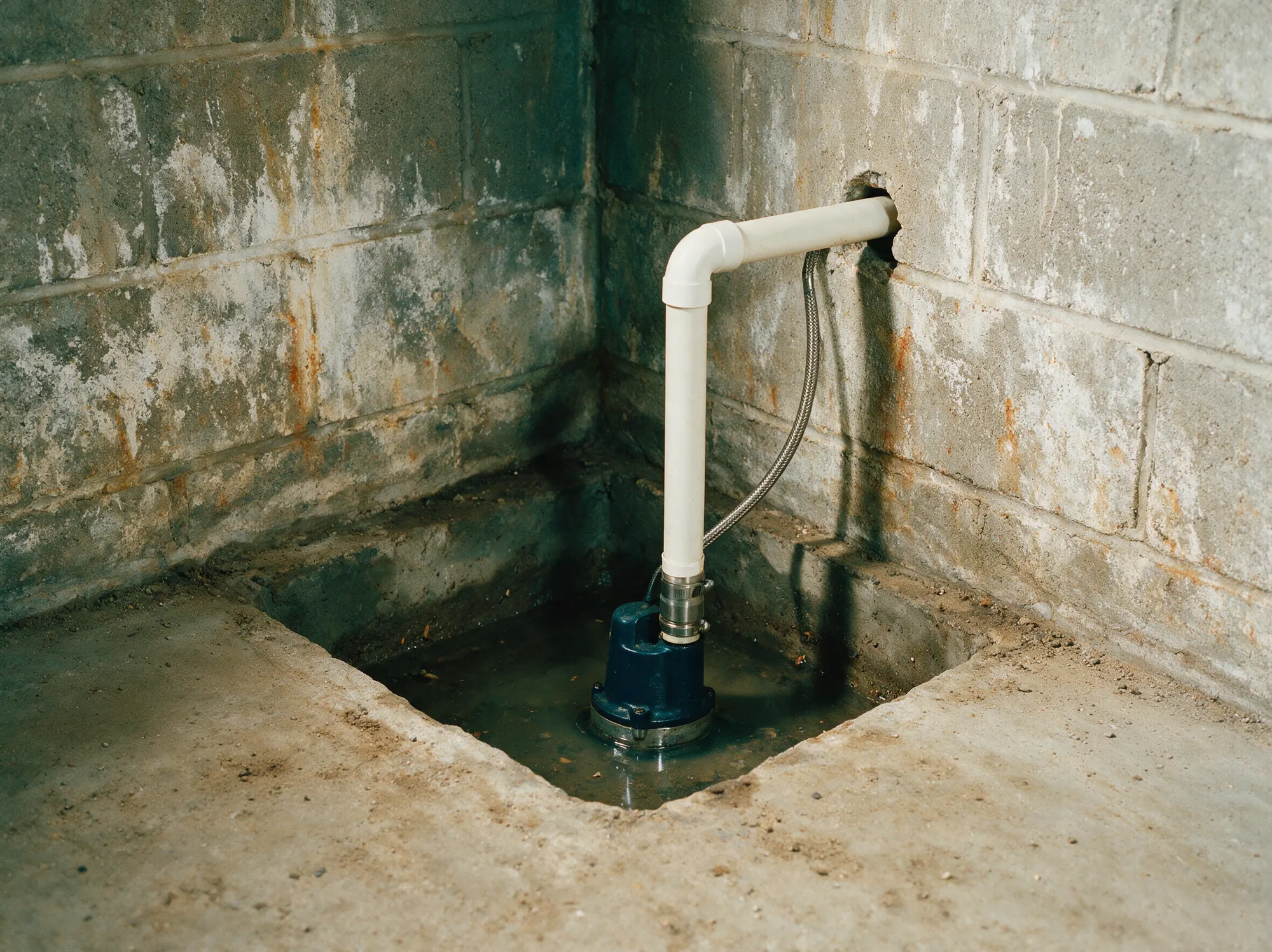
That changes what a sump is doing. In a modern house with an exterior footing drain and a poured wall, the pit collects from a designed system. In a pre-war basement here, the pit is often a hole cut in a floor that was poured over dirt, taking whatever finds it. Both need a working pump. The second one also needs someone to think about where the water is entering, because pumping it out forever is the expensive way to solve a grading problem.
Sealing the pit, and why it matters here
Dauphin County’s adopted design criteria list radon potential as High, and the county sits in EPA’s highest radon zone. A sump pit is an opening straight through your slab into the soil gas beneath it, which makes it a legitimate radon entry point as well as a drain.
So a pit here gets a sealed, gasketed lid with a grommet for the discharge and a proper cable pass-through, not a loose board or a bare hole. That also stops the pit acting as an open evaporation source in a damp basement and keeps small children and pets out of it. We are plumbers, not radon mitigators, and we will not tell you a lid fixes a radon reading — but leaving the hole open where the county rates the potential High is not a defensible way to install a pump.
The discharge line is what usually fails
A pump that hums and does not empty the pit is very often a pump doing its job into a blocked line. In winter that is a frozen discharge. The frost line here is 40 inches and the county’s winter design temperature is 0°F, and a sump discharge is almost never buried anywhere near that deep — it is a shallow run to daylight, sometimes lying on the ground under leaves.
- Give it fall the whole way. Any low spot holds water, and held water freezes first.
- Get it away from the wall. A discharge dumped three feet from the foundation is water going straight back into the pit. Ten feet is a minimum worth aiming for, further on a slope.
- Fit a freeze-relief or air-gap arrangement so that if the buried run does ice up, the pump has somewhere to put water instead of dead-heading.
- Check the end of the line in November. Mice nest in them, mulch buries them, and mowers flatten them.
- Keep roof leaders out of it. Downspouts discharging next to the wall put a remarkable volume of water directly into the ground your sump then has to pump.
The check valve deserves a mention too. It sits in the vertical discharge and stops the column of water in the pipe falling back into the pit each time the pump stops. When it fails, the pump lifts the same gallon repeatedly, cycles far more often than it should, and dies early. A pump that runs every ninety seconds in dry weather is telling you something.
Power, backups and the grinder pump overlap
The storms that fill a basement are the storms that take the power out, and a sump pump with no electricity is a decoration. That is a stronger argument here than in most places, because a household in the sewer extension corridors may have two pumps that stop when the power does — the sump in the basement and the grinder pump outside. One puts water on the floor. The other puts sewage in the basin with very little reserve.
Battery backup buys hours, not days, and the battery is a consumable that needs replacing on a schedule even if never used. A generator with a proper transfer arrangement covers both pumps and the freezer.
Test the pump properly twice a year, and test it the way it actually runs: fill the pit with a bucket until the float rises and the pump starts, rather than lifting the float by hand. Lifting the float tests the switch and nothing else. Watch that the water level drops, listen for the check valve to seat, and go outside to confirm water is leaving the end of the pipe. The general mechanics of pumps, pits and backups are on the sump pump page, and if the basement smell is sewage rather than damp, that is a different problem — see sewer and septic lines.
The general version
This page covers what’s different about sump pumps in Halifax. For how we approach the work generally — the diagnostics, the repair-or-replace reasoning, the parts — read the main page.
Sump Pumps