Upper Dauphin County gets a handful of nights every winter in the single digits. Those are the nights that produce the calls. But the pipe that freezes is almost never the one in the coldest room. It is the one sitting in a moving stream of cold air — through a foundation vent, past a gap at the rim joist, down a stud bay that was never insulated behind a sink somebody added in 1974.
Still air at 20°F will not freeze a copper line quickly. A 15 mph draft at the same temperature will freeze it in a couple of hours. That explains why one house on the block has trouble every winter and the identical house next door never does.
Which runs freeze first in an old house here
In the housing stock around here, much of it well over a century old and replumbed several times, the same handful of runs come up over and over.
- Kitchen sinks on an exterior north wall, where the supply was run up the outside stud bay because that was the short way to do it.
- Bathrooms added over a porch or a breezeway, with nothing under the floor but a soffit and cold air.
- Second-floor bathrooms added in the 1960s and 70s, with lines run through an attic knee wall above the insulation instead of below it.
- Sillcock lines and well lines, which are by definition in the cold — in the wall, in an uninsulated pit, or in an above-ground pump house.
- Anything near a bulkhead door that no longer seals, or a basement window with a broken pane and a rag stuffed in it.
Hot lines freeze too. A hot line unused since dinner is just a pipe full of cold water by three in the morning, and it usually runs in the same bay as the cold.
Why the burst happens where it does
Ice does not split the pipe by expanding against it. The split comes from pressure, and it happens somewhere else entirely.
Here is the sequence. An ice plug forms at the cold spot and grows along the pipe. Water is effectively incompressible, so the growing plug pushes the water ahead of it toward the nearest closed tap, and that column has nowhere to go. Pressure in the sealed section between ice and faucet climbs into the thousands of psi, and the pipe fails at the weakest point in that section — frequently several feet downstream, sometimes in a part of the house that never got cold at all.
Two things follow. Leaving a tap cracked open gives that pressure an escape route, which is the real reason a drip helps. And you rarely see water when the pipe splits, because the ice is still plugging the line — the flood arrives on the thaw. If you are about to warm a frozen run, shut the main first and open it slowly while watching.
Thawing safely, and the methods that start house fires
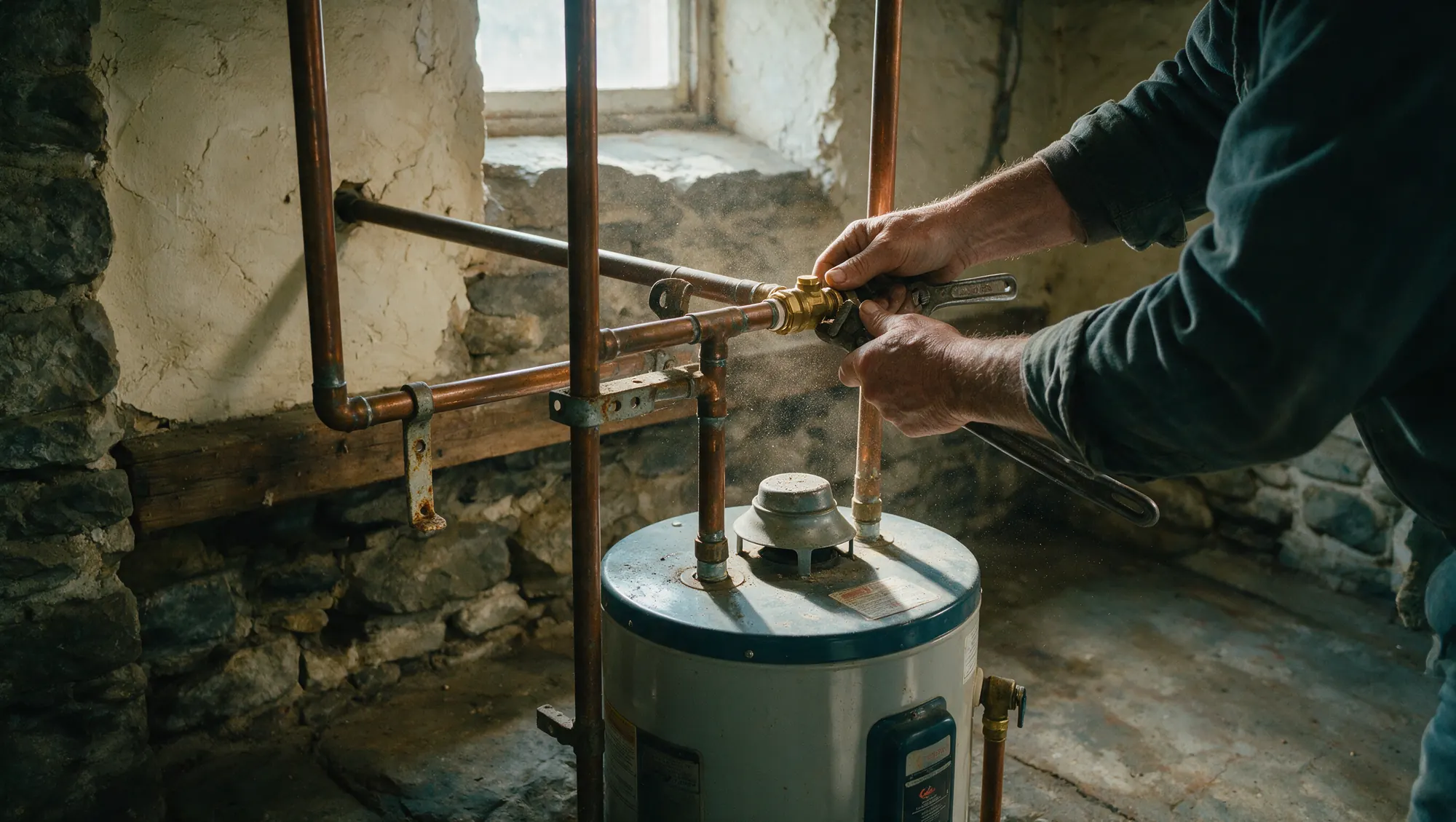
Open the affected tap first, so meltwater has somewhere to go and you can hear progress. Work from the tap end back toward the ice, never the other way — heating the middle of a plugged run traps meltwater and steam between two blockages.
What works: a hair dryer moved constantly along the pipe; a heat gun on low, also kept moving; hot wet towels wrapped around an accessible section; a space heater on the floor a safe distance away with the cabinet doors opened; heat cable installed to the manufacturer’s instructions and never overlapped on itself.
What starts fires: a propane torch. Every winter, somewhere in Pennsylvania, a house burns down because somebody put a flame on a pipe running through a wall of dry hundred-year-old framing and blown-in insulation. A torch also boils water inside a closed section and can rupture the pipe outright. The rest of the list is short and equally serious — unattended kerosene salamanders in crawlspaces, space heaters against combustibles, and extension cords buried under insulation.
If the frozen section is inside a finished wall or under a slab, that is where a homeowner should stop. Opening the wall in the right place is most of the work, and it is what frozen and burst pipe work is for.
October work that prevents January calls
The most important item on the autumn list takes thirty seconds and gets skipped constantly: take the garden hoses off.
A frost-free sillcock puts the actual valve seat a foot back inside the heated wall, so shutting it lets the barrel drain out through the spout. That only happens if the spout is open. Leave a hose attached and the barrel stays full, the water freezes, and the copper tube splits inside the wall. Nothing happens all winter, because the valve upstream is closed and the split is dry. Then in April you open the sillcock to wash the car and water pours into the basement from a pipe you cannot see. It is entirely preventable in October.
- Disconnect every hose, drain it and store it, and open the spout to let the barrel empty.
- On older non-frost-free sillcocks, close the interior stop and leave the outside spout open for the winter.
- Blow out or drain irrigation lines and anything feeding a garden, a barn or a stock tank.
- Seal rim joist penetrations, close crawlspace vents, weather-strip the bulkhead, and foam-sleeve exposed runs.
- Check the well pit or pump house insulation, and confirm any heat cable is intact and plugged in.
- Winterize outbuildings, campers and hunting cabins properly rather than hoping.
Letting a tap drip, and why it works
A drip helps for two reasons, and the smaller one gets all the attention. Moving water takes a little longer to freeze. The bigger benefit is that an open tap relieves the pressure that actually splits the pipe. Even if a plug forms, the water ahead of it has an exit.
Do it properly: a steady trickle about the thickness of a pencil lead, at the fixture farthest along the run most at risk, on both hot and cold if both lines run in that wall. Open the cabinet doors underneath. On a bitter night that is enough for most houses.
On a private well a drip costs a little electricity instead of water and will cycle the pump occasionally overnight. That is fine. A pump clicking on and off every few seconds is not. That is a separate fault, covered under well pumps and pressure tanks, and worth sorting before you leave it running all night.
A house left empty in winter
There are two honest options for a house nobody is living in: heat it, or drain it. Half measures produce the catastrophic losses.
If you are heating it, hold 55°F, leave interior doors and vanity cabinets open so heat reaches the pipe chases, and have somebody look at the place weekly. A furnace that quits on the 20th and is found on the 3rd is the difference between a service call and a gutted house. A cheap temperature alarm that texts you is worth more than any of that.
If you are draining it, do it thoroughly: shut the main, open every tap hot and cold, drain from the lowest point, blow the lines out with compressed air, drain the water heater and the pressure tank, then put RV antifreeze — not automotive — into every trap and toilet bowl and sponge the tanks out. Do not forget the washing machine, the dishwasher and the ice maker line. It is worth having done properly once on a camp or a second property, so you can copy the procedure yourself afterwards.
- First to freeze
- Any run in a draft — not the coldest room
- Where it splits
- Between the ice plug and the closed tap
- Drip size
- A steady trickle, about a pencil lead
- Empty house minimum
- 55°F, checked weekly — or fully drained
- Never
- An open flame on a frozen pipe