The worst possible time to learn where your main shut-off is, is while water is coming through the kitchen ceiling. On a dry afternoon it takes ten minutes to find it, turn it and tag it. At eleven at night with a flashlight in your teeth, the same search takes twenty minutes you do not have. The difference is usually a floor.
Every house has one. Inside the boroughs, on public water, it is nearly always a few feet inside the foundation wall on the side facing the street. Out in the townships on a well, it sits at the pressure tank instead, and there is a second thing to shut off as well.
This is the homework we ask of every homeowner, whether we have ever set foot in the house or not. Find the valve. Turn it. Label it. Tell everyone else in the house.
Where the valve actually is
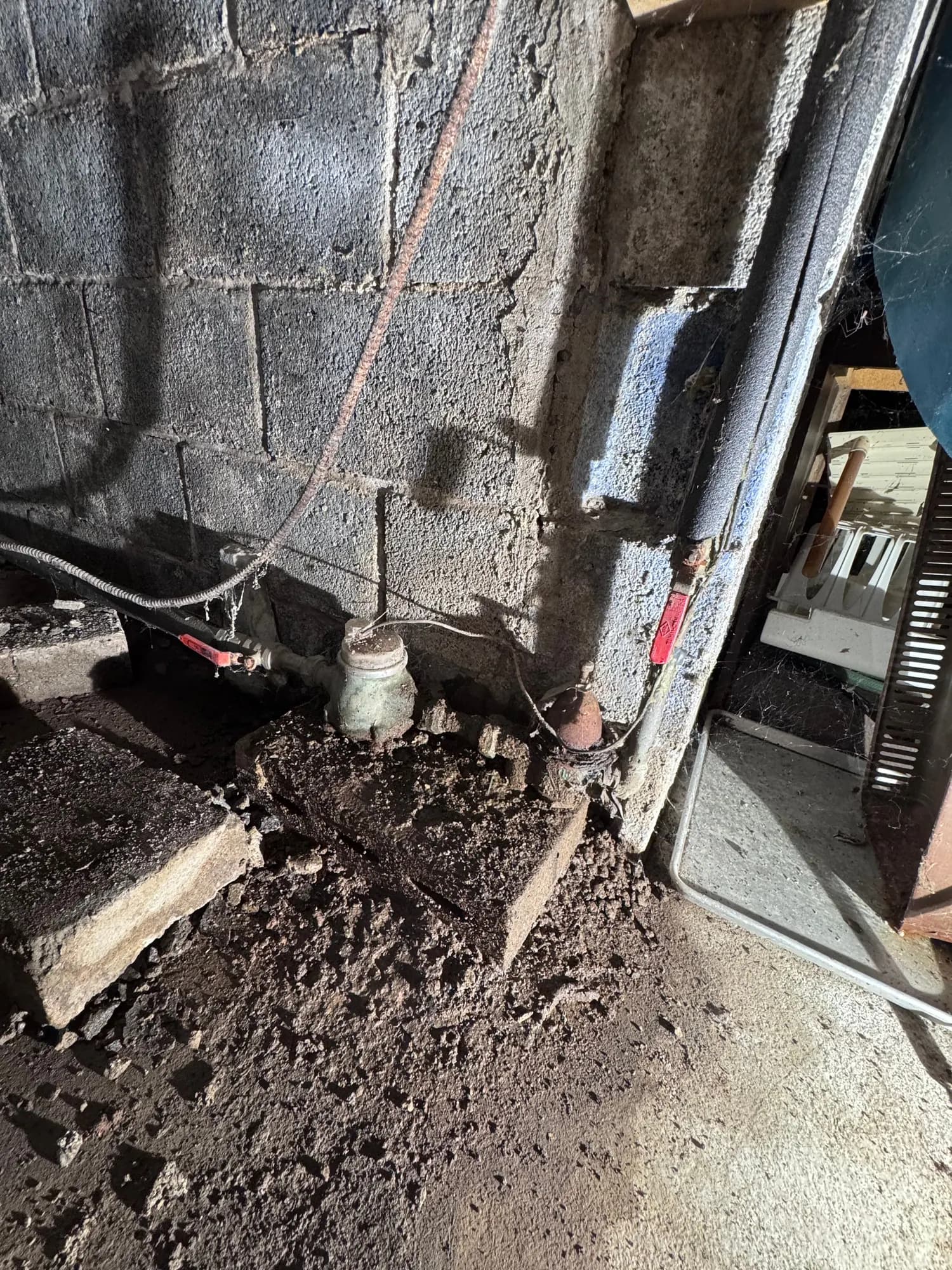
On public water, the service line comes in below the frost line and passes through the foundation wall on the street side. Walk that wall and look for a copper or plastic pipe coming out of the block or stone, usually between knee and shoulder height. In most older borough houses the meter is right there with a valve on each side of it — the street-side one is your main. Some newer services put the meter in an outside pit with a remote reader, in which case you will find only the one valve indoors.
On a well there is no meter and no borough valve. Water goes from the pump into the pressure tank, and the main shut-off sits on the outlet side of that tank, past the tee carrying the pressure switch and gauge. Closing it does not stop the pump, which will keep building against a closed valve — so shut the pump breaker too, and label that breaker while you are at it. The rest of that system is covered under well pumps and pressure tanks.
Not every house cooperates. Ranch houses on a slab out in the townships often put the shut-off in a utility closet, in the garage, or under the kitchen sink. With no basement, start at the water heater and work backwards. The cold feed comes from somewhere, and that somewhere is generally near the main.
Gate valves, ball valves, and the one that won’t close
A ball valve has a lever handle and turns a quarter of a turn. Lever in line with the pipe means open; lever crosswise means closed. It is obvious at a glance, it seals reliably, and it does not much care how long it has been sitting.
A gate valve has a round wheel handle and takes several full turns. Inside it a brass wedge rides up and down on a threaded stem, and that is the design in most Upper Dauphin houses built before the mid-1980s. Its failure mode is worth understanding. Scale locks the wedge in place, or corrosion eats through where the wedge meets the stem. You spin the handle, it turns freely, and nothing happens. The other version is a valve that closes most of the way and never seals, so the flow drops to a dribble and stays there.
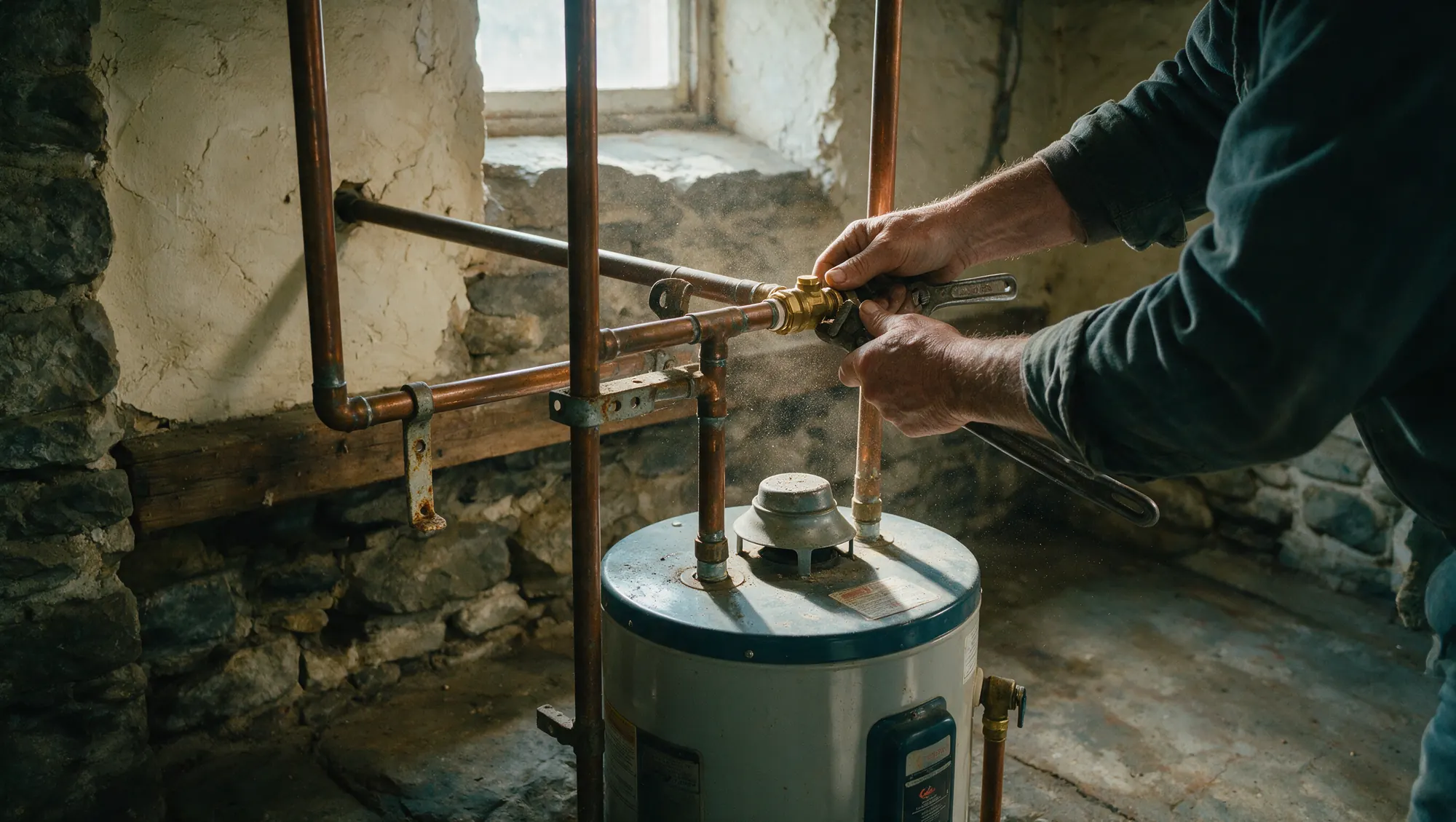
If your house still has the original gate valve at the main and nobody has turned it in ten years, plan on it not working. Swapping a main shut-off for a full-port ball valve is a small, quick piece of plumbing repair, and it is the cheapest insurance in the building.
Exercising the valve twice a year
Valves seize because they sit. Pick two dates you will remember, such as the weekends the clocks change, and give the main a workout.
- Open a tap on the lowest floor so you can hear and see what happens.
- Close the main slowly — several turns clockwise on a gate valve, a quarter turn on a ball valve. The tap should die to a dribble and stop.
- Leave it closed for a minute, then reopen it fully. On a gate valve, back the handle off a quarter turn from wide open — a wheel jammed hard against its stop is the one most likely to seize shut.
- Watch the valve body and the packing nut under the handle for a weep. A snug eighth of a turn on the packing nut usually stops a light one.
- Come back in an hour and look again. A valve that has not moved in twenty years will sometimes start weeping after it is disturbed.
That last point puts people off doing it at all, which is backwards. If the valve is going to fail, you want it failing on a Saturday morning with a bucket in your hand, not in February with the ceiling coming down.
The curb stop is the authority’s, not yours
Between the water main under the street and your house there is another valve, the curb stop, sitting in a buried box with a small iron lid — usually in the grass strip between the sidewalk and the curb, sometimes in the sidewalk itself. It closes with a long T-handled key that reaches four or five feet down, and it belongs to the water authority, not to you. They will come and shut it. That is what the phone number on the water bill is for.
Do not go at it with a screwdriver and a pair of pliers. Snapping the operating nut off a curb stop turns a phone call into an excavation in the street, and that bill lands on the property owner. On a well there is no curb stop; the pump breaker is the equivalent.
The stops you will actually use more often
Most leaks are local. A toilet fill valve, a faucet supply, an ice maker line, a washing machine hose. Under every toilet and sink there should be an angle stop, and shutting one fixture beats shutting the whole house while you sort it out.
The old chrome multi-turn stops with a rubber washer are the ones that let people down. They seize, and when they finally move, the washer has gone hard and the stop keeps passing water. Quarter-turn ball stops do not have that problem. Replacing them is a sensible thing to bundle in whenever a fixture is being changed anyway, which is why we usually raise it during toilet and faucet work.
The laundry connection deserves its own mention. Rubber washing machine hoses fail with age, under full pressure, with nobody home. Braided stainless hoses and a single-lever laundry valve you can knock shut on the way out are worth the small effort.
Label it so anyone can find it in the dark
A valve only helps if the person standing in front of it knows what it does. Zip-tie a bright tag to the handle and write on it in permanent marker: MAIN WATER SHUT-OFF, and which way closes it. Then do the rest of the list.
- Photograph it and keep the picture on your phone. It saves a lot of explaining over the telephone.
- Show everyone in the house, teenagers included, and whoever watches the place when you travel.
- Keep the path clear. Boxes and storage stacked in front of the shut-off cost you minutes at exactly the wrong time.
- On a well, tag the pump breaker too — the panel is often on the other side of the basement from the tank.
- Public water
- Inside the foundation wall, street side, at the meter
- Private well
- Outlet side of the pressure tank — plus the pump breaker
- Ball valve
- Quarter turn; lever crosswise = closed
- Gate valve
- Several turns clockwise; exercise twice a year
- Curb stop
- The water authority’s valve, not the homeowner’s