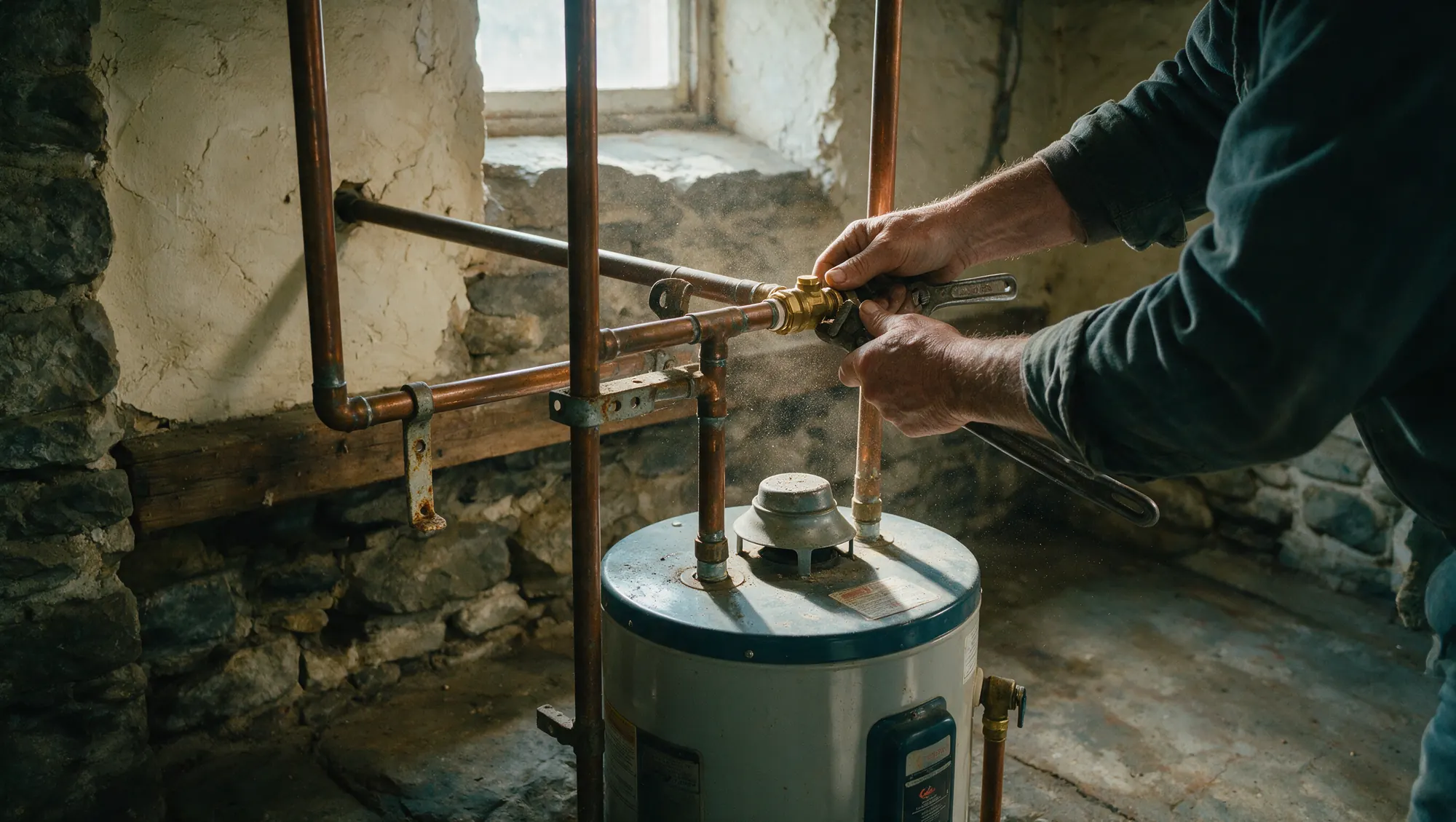
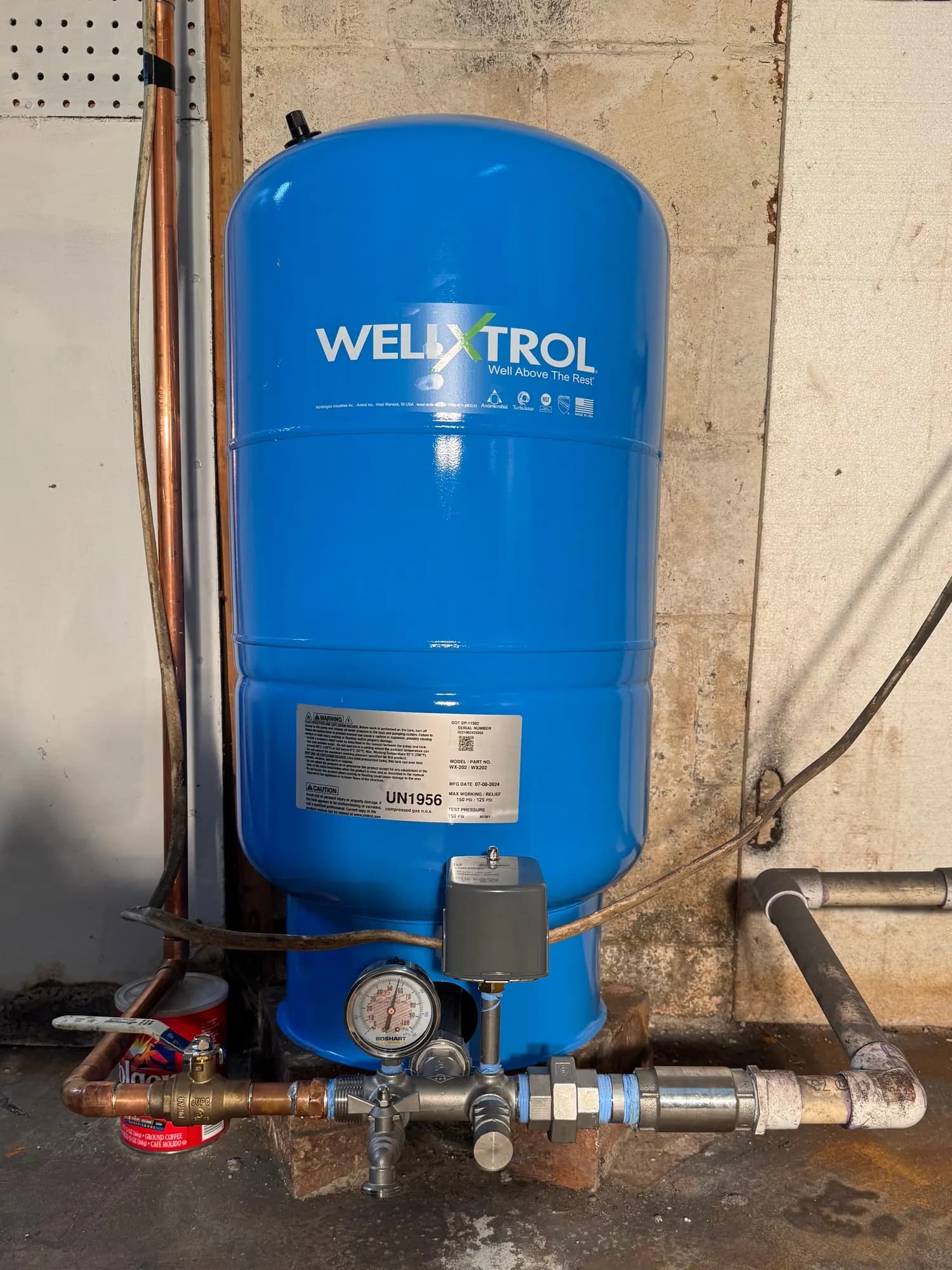
Outside the boroughs, most houses draw from a private well, and the system comes down to four things: a pump down in the hole, a pressure tank, a pressure switch, and the wiring between them. Three of those sit in your basement where you can look at them, and a surprising share of the calls that begin with “I think the pump is going” end at one of the three.
That matters, because the pump is the expensive part and the one nobody reaches without pulling several hundred feet of pipe and wire out of the ground. Before anyone does that, the cheap components deserve ruling out properly.
Short-cycling destroys pumps faster than anything else
If you turn on a tap and the pump starts and stops every few seconds, switch clicking each time, go shut the breaker off before you read the rest of this.
A motor draws several times its running current every time it starts, and that inrush makes heat. A submersible is cooled by water moving past it and is designed around a modest number of starts per day; short-cycling can put thousands on it in an afternoon. Bearings go first, switch contacts pit and weld, and a pump that had eight years left can be finished in a day or two.
The usual cause is not the pump. It is a pressure tank that has lost its air charge or burst its bladder, so there is almost no stored water and the pump restarts the moment anything is drawn. Also: a leak in the system, a failing pressure switch, a check valve leaking back, or a plugged bleeder on an older galvanized tank. All of it is worth sorting before it takes the pump with it, and all of it falls under well pump and pressure tank work.
Reading the pressure gauge
The gauge on the tank tee is the most informative thing in the basement, and most people have never watched it for two minutes. Standard switches are set 30/50 or 40/60 — cut-in at 30 or 40 psi, cut-out at 50 or 60, a 20 psi differential. A healthy cycle looks like this: with a tap running, the needle falls steadily to the cut-in figure, the pump starts, the needle rises steadily to cut-out, and the pump stops.
- With nothing running, the needle should sit still. If it drifts down and the pump kicks on with the house asleep, you have a leak or a check valve letting the column run back down the well.
- Time the run. With a steady flow, a tub filling or a hose, time from pump start to pump stop. Under thirty seconds means too little stored water. A minute or more is healthy.
- A needle that climbs and stalls below cut-out means the pump cannot make pressure: worn impellers, a hole in the drop pipe, a partly closed valve, a fouled filter, or low water in the well.
- Readings that make no sense are often a dead gauge. It is the least expensive component on the system, and one that clogs and fails regularly. Replace it before you believe it.
No water at all: the order to check
- Whole house, or one fixture? One dead fixture is not a pump problem — check that fixture’s stop valve and aerator.
- Cycle the breaker. Do not just look at it. A tripped double-pole breaker can sit in a position that looks closed. Push it firmly off, then on.
- Read the gauge. Zero psi and 50 psi are two different stories. If it reads 50 and nothing comes out of the taps, the pump is fine and something downstream is blocked — very often a sediment filter cartridge nobody has changed.
- Listen at the tank and the switch. A hum means the motor is trying and something is stopping it. Repeated clicking means the switch is calling. Silence means no power, or no call for water.
- Look at the pressure switch with the power off. Burnt or pitted contacts are common, and so are ants, which nest inside switches and bridge the contacts often enough here to be worth a look.
- A shallow-well jet pump may have lost its prime, which is recoverable; a submersible cannot lose prime. In winter, also consider a frozen line — the run into the house, the pitless adapter, or a pump house.
- Consider the well itself. After a dry summer, or heavy irrigation, the level can drop below the pump. If water returns after several hours of no use, that is a yield problem, not equipment.
- Stop there. What comes next involves 240 volts, a control box holding a charge, and possibly pulling the pump.
The waterlogged tank, and the tap test
A pressure tank is a steel drum with a rubber bladder inside. Air is pre-charged on one side, water fills the other, and that compressed air pushes water into the house between pump starts. Correct pre-charge is 2 psi below cut-in — 28 psi on a 30/50 switch, 38 on a 40/60 — measured with the tank drained.
The free diagnostic is your knuckles. Rap the side of the tank from the top down. A healthy tank rings hollow up high and goes dull lower, with an obvious transition where the water sits. A waterlogged tank sounds dull all the way up, because there is no air left in it — and that is your short-cycling.
The second check is the air valve on top, which looks like a tire valve. With the power off and the tank drained, put a tire gauge on it and compare it to the figures above. If water squirts out instead, the bladder has ruptured and the tank is finished. Older galvanized tanks with no bladder are different: they waterlog naturally and are meant to have their air replenished, which is what the snifter and bleeder fittings were for.
Air spitting from the taps, and sand
Taps that sputter and spit air have a short list of causes, and they are not equally serious. A ruptured bladder pushes its air charge into the plumbing, which points at a tank replacement. A pump breaking suction because the water level has dropped to the intake is far worse — it delivers slugs of air and water, runs without cooling, and can destroy itself. If the spitting follows a dry stretch and eases after several hours of no use, treat it that way. Dissolved methane also produces air at every tap in parts of Pennsylvania, and that needs testing rather than guessing.
Sand is its own warning. Water that turns gritty means something changed down the hole: a failed screen, a pump set too near the bottom, a silting well, or a rock borehole that sloughed in. Sand grinds impellers, cuts check valve seats, blocks aerators, and settles into the water heater and toilet tanks.
A spin-down separator or a sediment filter keeps grit out of the house, but neither answers why it started, and sometimes raising the pump a few feet solves it outright. Where the water is also hard, iron-bearing or smells of sulfur, sediment is one part of a bigger picture — the ground covered by water treatment.
What you can safely check, and what you cannot
Safe: the breaker, the gauge and how it moves, the knuckle test, the air pre-charge with power off and the tank drained, the sediment filter, and walking the house for a running toilet that would explain a pump cycling at night. Write down what you find — it shortens the visit.
Not safe: opening the control box, which stores a charge after the power is off; working inside a live pressure switch; pulling a submersible; and taking the cap off the well head. That last one matters — ten minutes of open casing is enough for a coliform hit, and clearing one costs a lab test and a shock chlorination.
- Common switch settings
- 30/50 and 40/60 psi (cut-in / cut-out)
- Tank pre-charge
- 2 psi below cut-in, tank drained
- Healthy pump run
- A minute or more, not thirty seconds
- Short-cycling
- Shut the breaker — it destroys the motor
- Never open
- The control box, or the well cap