A half-inch supply line under household pressure will put several gallons a minute into your house, and it will keep doing it until somebody closes a valve. That is the whole shape of the problem. Everything else — the drying, the drywall, the flooring, the claim — is downstream of how many minutes the water ran.
So the sequence below is deliberately in this order. It is tempting to grab towels first, and towels are the last thing that matters. Read it now, while nothing is wrong, and put a copy on the inside of a cabinet door.
One note before the list: if the water is anywhere near an electrical panel, an outlet, or an appliance you would have to stand in water to reach, none of the following applies. Get everyone out and call the power company from outside.
The first five minutes, in order
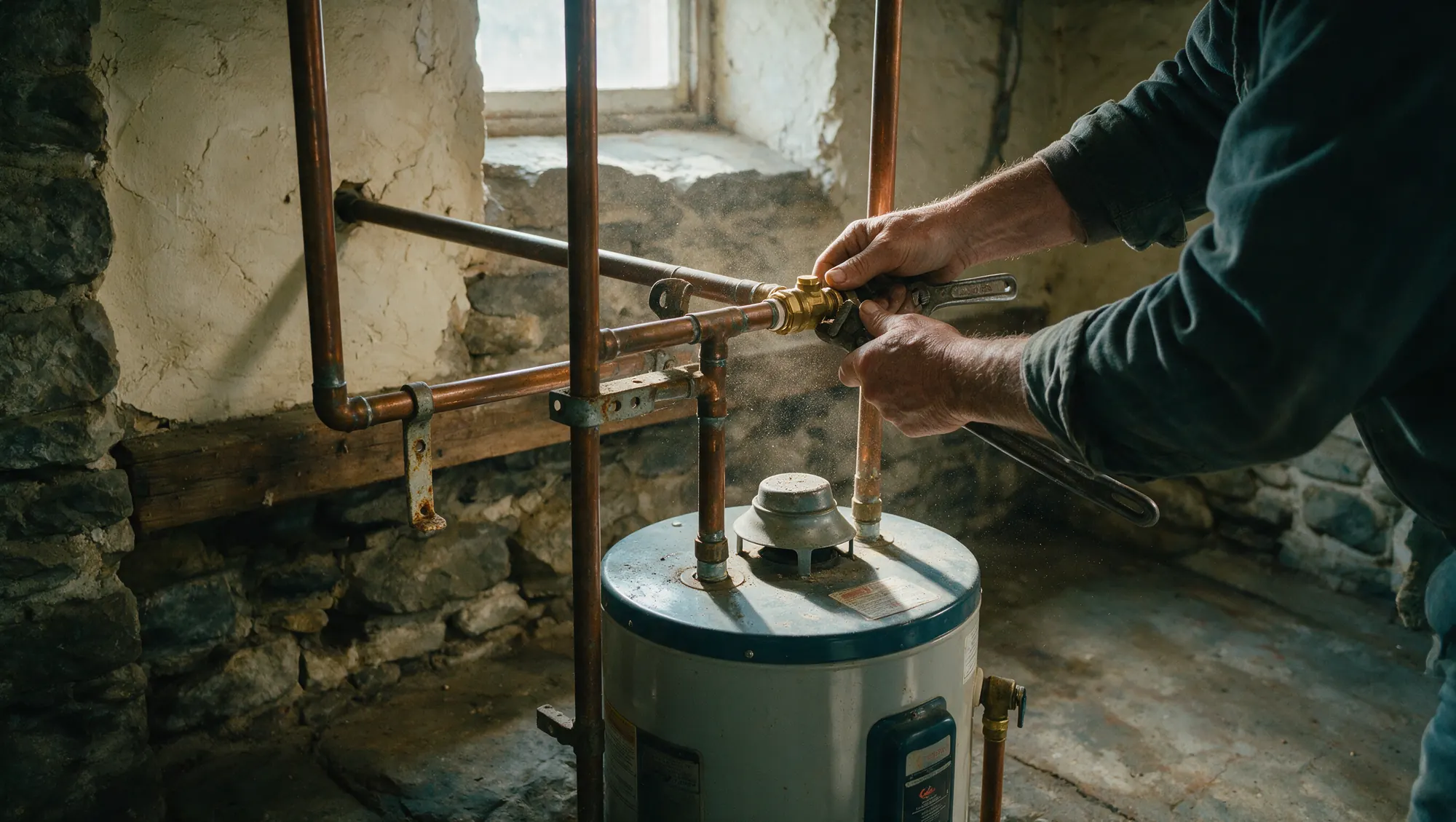
- Shut the main. On public water that is the valve inside the foundation wall on the street side, at the meter. On a well it is the valve at the pressure tank — and shut the pump breaker too, because closing that valve does not stop the pump.
- Kill power to the affected area at the panel. Turn off the breakers for the circuits in the wet rooms. Do not reach for a wall switch in a wet room, and do not walk through standing water to get to the panel. If the panel itself is wet or unreachable, leave the building and call the utility.
- Open the taps. Start with the lowest fixture in the house, hot and cold, then work upward. That drains the water still sitting in the pipes and drops the pressure, so the break stops producing. Flush each toilet once.
- Shut down the water heater. Gas control to the off position, or the breaker off on an electric unit. A heater firing on a draining tank damages itself in a hurry.
- Photograph everything before you touch anything. Wide shots of each room, then close shots of the break, the water line on the wall, the ceiling, the flooring, and every damaged possession. Take a slow video walking through and narrating. Your phone timestamps all of it, and that is worth a great deal later.
- Then call. Tell us what you shut off, where the water came from and what you can see. That call is more useful than any amount of toweling.
What not to do
- Do not turn the power back on to a wet circuit to see if it works.
- Do not use a household vacuum, an extension cord, or a shop vac that is not rated for water, in or near standing water.
- Do not put a flame on a frozen pipe to free the blockage. That is how house fires start, and it can rupture the pipe outright.
- Do not throw damaged property away before it is photographed and, where a claim is involved, before the adjuster has agreed. Bag it and set it aside instead.
- Do not start cutting out drywall before you have documented the room as it is.
- Do not leave a well pump running against an open break. It will run continuously and can burn out.
- Do not pour bleach around a wet basement. It does not stop mold growth in materials and the fumes in a closed space are a problem of their own.
What your insurance company will ask for
Every policy is different and yours is the one that counts — read it, or call your agent and ask them to walk you through the water sections. But the questions are broadly the same, and knowing them in advance is why the photography step sits where it does.
- When you discovered it, and when it likely started. A slow leak found late is treated very differently from a sudden break.
- Photographs and video taken before mitigation. This is the one homeowners most often miss, and it is the one that carries the most weight.
- What you did to limit the damage, and when. Most policies place a duty on you to mitigate. Note the times you shut the water off, opened the taps and called for help.
- Receipts for anything you buy — fans, a dehumidifier, a wet vac rental, a motel night.
- The plumber’s invoice describing the cause, which is what determines how the claim is treated.
- Whether the house was occupied and heated. This one matters enormously for a winter loss in a second home or a hunting camp, and it is the question people are least prepared for.
One distinction worth understanding now rather than later: sudden and accidental discharge from a plumbing system is treated differently from long-term seepage, and both are treated differently from surface water coming in from a swollen creek. Rising water from the Wiconisco or the Susquehanna is flood, and flood is a separate policy that most households here do not carry unless a lender required it. Find out which of those you have before the day you need to know.
Reducing the damage while you wait
Once the water is off and the room is documented, the clock that matters is the mold clock — roughly twenty-four to forty-eight hours in wet organic material. Everything below is aimed at that.
- Move what you can out of the water. Lift rugs, get books and cardboard off bottom shelves, and put foil or blocks under furniture legs so the finish does not bleed into carpet.
- Get the standing water out with a mop, a squeegee toward a floor drain, or a water-rated wet vac on a dry circuit.
- Open cabinet doors, pull out drawers, and lift the tack strip on carpet edges if you know how.
- Move air. Box fans on the wet surfaces, doors open between rooms, a dehumidifier if you have one. Keep the heat ordinary — steady drying, not a sauna.
- Drywall wicks upward from the floor. A wet baseboard usually means the bottom several inches of the wall are wet too, even if it looks fine.
If a ceiling is bulging and holding water, do not stand under it. From well to the side, with a bucket positioned and a screwdriver at arm’s length, put one small hole at the lowest point of the bulge and let it drain in a controlled way. A ceiling that lets go on its own takes the whole sheet, the insulation and whatever is above it.
Why it burst, and whether it will happen again
The repair is one question and the cause is another, and the second one determines whether you are doing this again next winter.
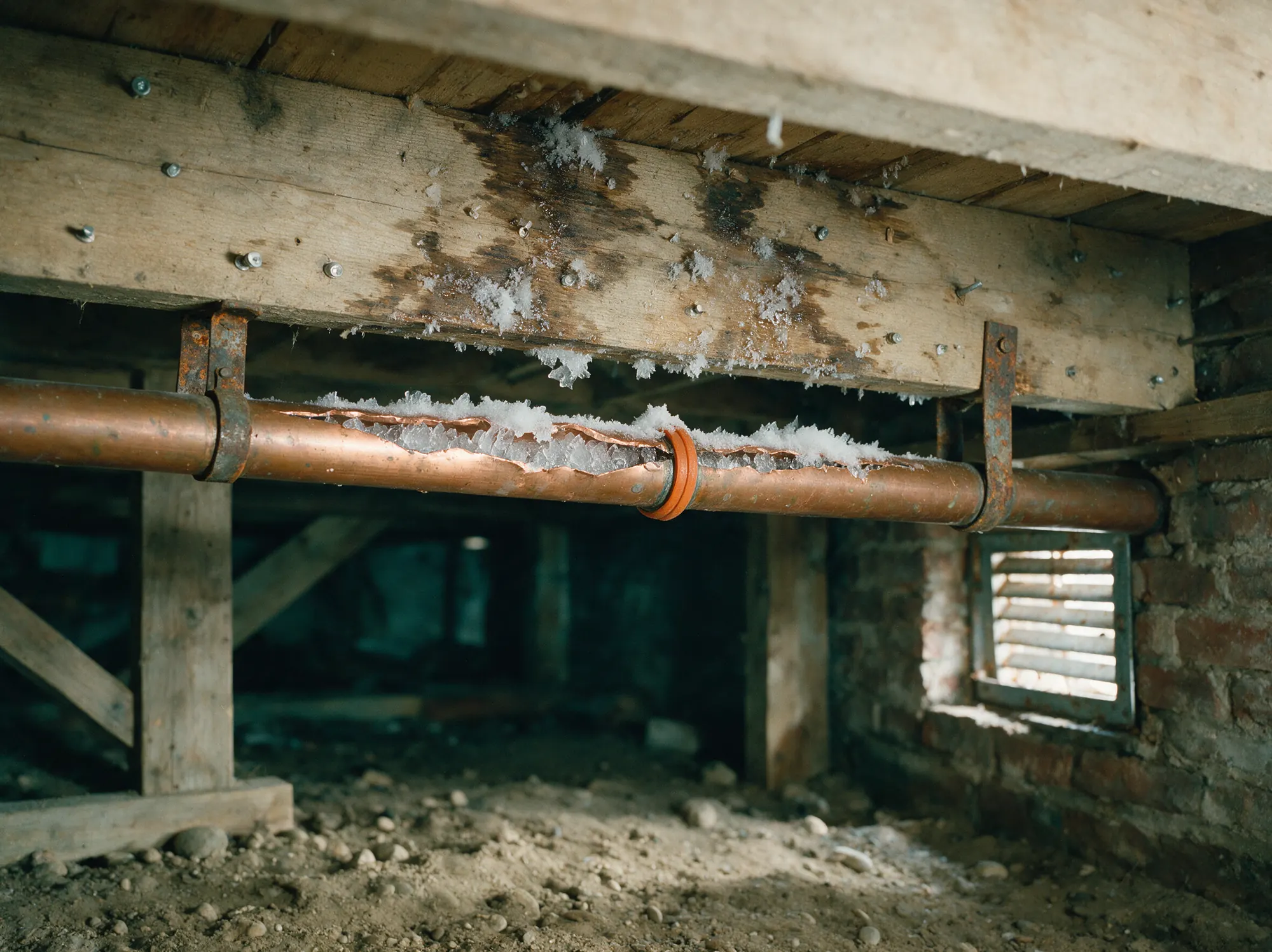
Freezing is the common cause here, and the split is often several feet from where the ice actually formed — there is more on that mechanism, and on preventing it, in our work on frozen and burst pipes. The other repeat offenders are age and chemistry: the last stretch of original galvanized in a house that has been partly repiped, copper thinned by acidic well water until it pinholes, CPVC that has gone brittle near a heat source, and old poly fittings that let go at the crimp.
Then there is pressure, which is worth checking on any house that has had more than one failure. A hose-bib gauge costs very little. Anything over 80 psi is above what code allows for a dwelling and is hard on every fitting, every fill valve and every appliance hose in the building; the answer is a pressure reducing valve on the incoming service, and an expansion tank if the system is closed. Sorting that out is straightforward plumbing repair and it prevents the next one.
- Step one, always
- Shut the main — before anything else
- On a well
- Close the tank valve and shut the pump breaker
- Before cleanup
- Photograph and video every room
- Mold clock
- Roughly 24–48 hours
- House pressure
- Over 80 psi needs a reducing valve