Outside the boroughs, nearly everyone is on a private well, and nearly every well has some character to it. Orange staining in the toilet tank. Scale on the kettle. A smell in the shower. None of it is unusual, and most is solvable.
What wastes money is treating a symptom without measuring the cause. A softener does nothing for a sulfur smell. A carbon filter does nothing for hardness. An iron filter set up for the wrong kind of iron plugs solid in a month. The most expensive mistake of all is a whole-house system installed to cure a smell that came from inside the water heater.
Pennsylvania is one of very few states with no statewide construction standard for private water wells, and nobody is required to test one. The whole responsibility sits with the homeowner — which is annoying, but it also means the picture is knowable for the price of a lab report.
Test before you buy anything
Use a state-accredited laboratory for the results that matter. Color-strip kits give a rough sense of hardness and pH and are useless for a health decision.
- Total coliform and E. coli — every year, without exception, and after any work on the well.
- Nitrate and nitrite — especially downgradient of cropland or a barnyard. The drinking water limit is 10 mg/L as nitrogen, and it is a genuine risk for infants under six months.
- pH and total alkalinity — these decide whether the water is eating your copper, and whether iron treatment will work at all.
- Hardness, iron and manganese — the three behind most visible complaints.
- Sulfate and hydrogen sulfide if there is a taste or an odor.
- Lead if the house predates 1986, and arsenic or radon in water, both of which turn up in parts of Pennsylvania.
Sample exactly as the lab instructs, from a tap ahead of any existing treatment, and keep the report. Test again after a system goes in — treatment with no before-and-after numbers is an act of faith.
Hardness, in grains per gallon
Hardness is dissolved calcium and magnesium. Labs report it in milligrams per liter as calcium carbonate; the plumbing world uses grains per gallon, and one grain is 17.1 mg/L. The scale runs: under 1 gpg soft, 1 to 3.5 slightly hard, 3.5 to 7 moderately hard, 7 to 10.5 hard, 10.5 to 14 very hard, above 14 extremely hard. Wells drawing from limestone — a fair description of much of the valley ground here — commonly land in the last two bands.
You will already know if you have it. Soap that will not lather, a curd ring in the tub, spotted glassware, stiff towels, white crust at the aerators, and scale inside the water heater that shortens the life of the tank.
The remedy is ion exchange — a softener sized in grains per day, roughly the number of people times about 75 gallons times your hardness figure. Be clear about what it does not do: it does not disinfect, does not fix taste or odor, does not remove much iron, and it adds a regeneration discharge that matters on an on-lot septic system. Sizing that against real numbers is the substance of a water treatment conversation.
Ferrous or ferric — and the black specks
Iron comes in two forms and they need different equipment. Fill a clear glass straight from the tap, look at it immediately, then look again twenty minutes later.
Ferrous iron, or clear-water iron, is dissolved. The glass is clear at first and turns yellow, then orange, as oxygen reaches it. This is the one that stains the toilet tank overnight. At low levels a softener holds it; above roughly three parts per million, or where the pH is wrong, you need oxidation followed by filtration — typically an air-injection or catalytic media filter.
Ferric iron, or red-water iron, is already oxidized when it arrives, so the water comes out of the tap orange or cloudy. Being particulate, it needs filtration, and it will foul a softener resin bed placed in front of it.
Iron bacteria are a third thing, and the giveaway is texture: reddish-brown slime in the toilet tank, a sheen on standing water, filters plugging far faster than they should. No filter fixes it — it calls for shock chlorination of the well, sometimes continuous chlorination afterwards.
Manganese is iron’s companion and shows up as black or gray-black specks — flecks in the ice, a dark smear in the toilet, greying laundry, black grit when a heater is drained. It is harder to remove because it needs a higher pH to oxidize, so treatment usually means correcting pH first. The secondary standard is 0.05 mg/L, and the guidance for infants is lower.
The sulfur smell: whole house, or just the heater
This is the most useful five seconds in the subject. Run a cold tap that does not pass through the water heater and smell it. Then run the hot.
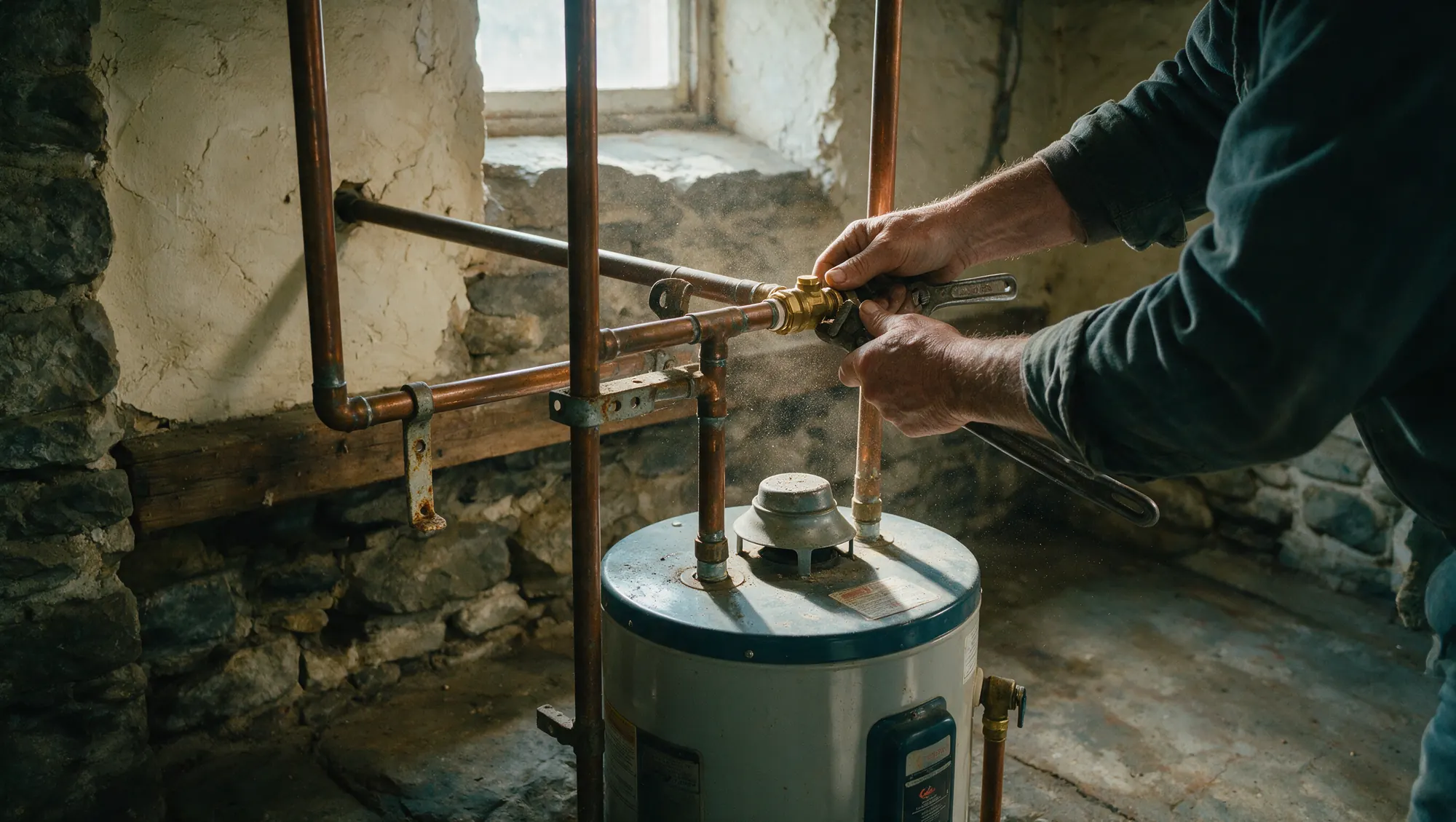
If the smell is only on the hot, the well is not the problem. Sulfate-reducing bacteria inside the tank react with the magnesium anode rod to produce hydrogen sulfide. The fix is at the heater: an aluminum-zinc or powered anode, disinfection of the tank, and in stubborn cases a period at raised temperature to kill the bacteria, with a mixing valve fitted so nobody gets scalded. That is a water heater job rather than a treatment system.
If it is on both hot and cold, and at the outside spigot too, it is in the supply. Options scale with severity: catalytic carbon for a faint smell, air injection with an oxidizing filter for a moderate one, continuous chlorination followed by carbon for a heavy one. The test says which band you are in.
And if it is only at one fixture, pour a glass and carry it into another room. If the glass smells fine, the problem is biofilm in that drain, not your water. That misdiagnosis is common enough to be worth ruling out first.
Acidic water and copper pinholes
A good deal of Pennsylvania groundwater is naturally acidic, particularly in shallow wells and where the bedrock is sandstone or shale rather than limestone. A pH of 5.5 to 6.5 is not unusual, and water like that dissolves the inside of copper tube.
The symptoms arrive in order. A metallic taste, and blue-green staining in the tub below a dripping tap. Green crust at fittings. Then pinhole leaks — usually in horizontal copper in the basement, often on the hot side first because the reaction runs faster warm. One pinhole is rarely the last, because every foot of that pipe has been thinned by the same water, which is why the honest conversation after the second or third is about replacing a section rather than patching again. That is the ground covered under pipe and leak repair.
Fixing the cause means raising the pH: a neutralizer tank of calcite, or calcite blended with a magnesium media, dissolves slowly into the water and brings it toward neutral. It also adds hardness, so on already-hard water it goes ahead of the softener; where hardness is high, soda ash injection is used instead. If your pH is low and the house has pre-1986 solder joints, test for lead too.
The order things go in
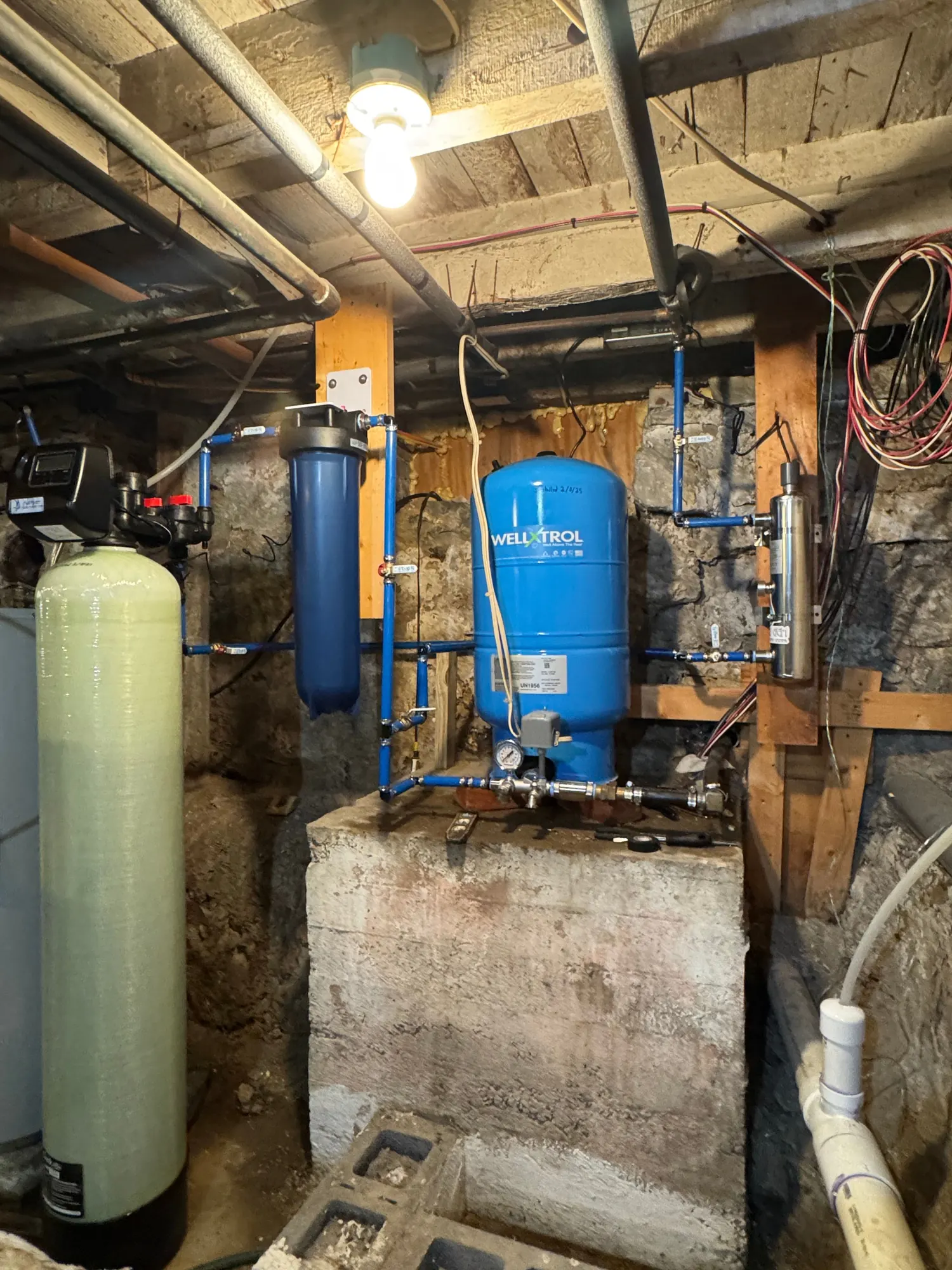
Treatment equipment has to be sequenced or it fights itself. A softener ahead of an iron filter fouls; a neutralizer after a softener does nothing useful.
- Deal with any bacterial result first — shock chlorination, and find how it is getting in.
- A sediment prefilter, sized to the grit present.
- pH correction, if the water is acidic. Everything downstream works better at neutral pH.
- Oxidation and filtration for iron, manganese and sulfide.
- Softening for hardness.
- Carbon polishing for taste and odor.
- Reverse osmosis at the kitchen sink, if a specific contaminant calls for it.
- Hardness conversion
- 1 grain per gallon = 17.1 mg/L
- Hard water
- Above 7 gpg; very hard above 10.5
- Nitrate limit
- 10 mg/L as nitrogen
- Manganese
- 0.05 mg/L secondary standard
- Smell on hot only
- The anode rod, not the well