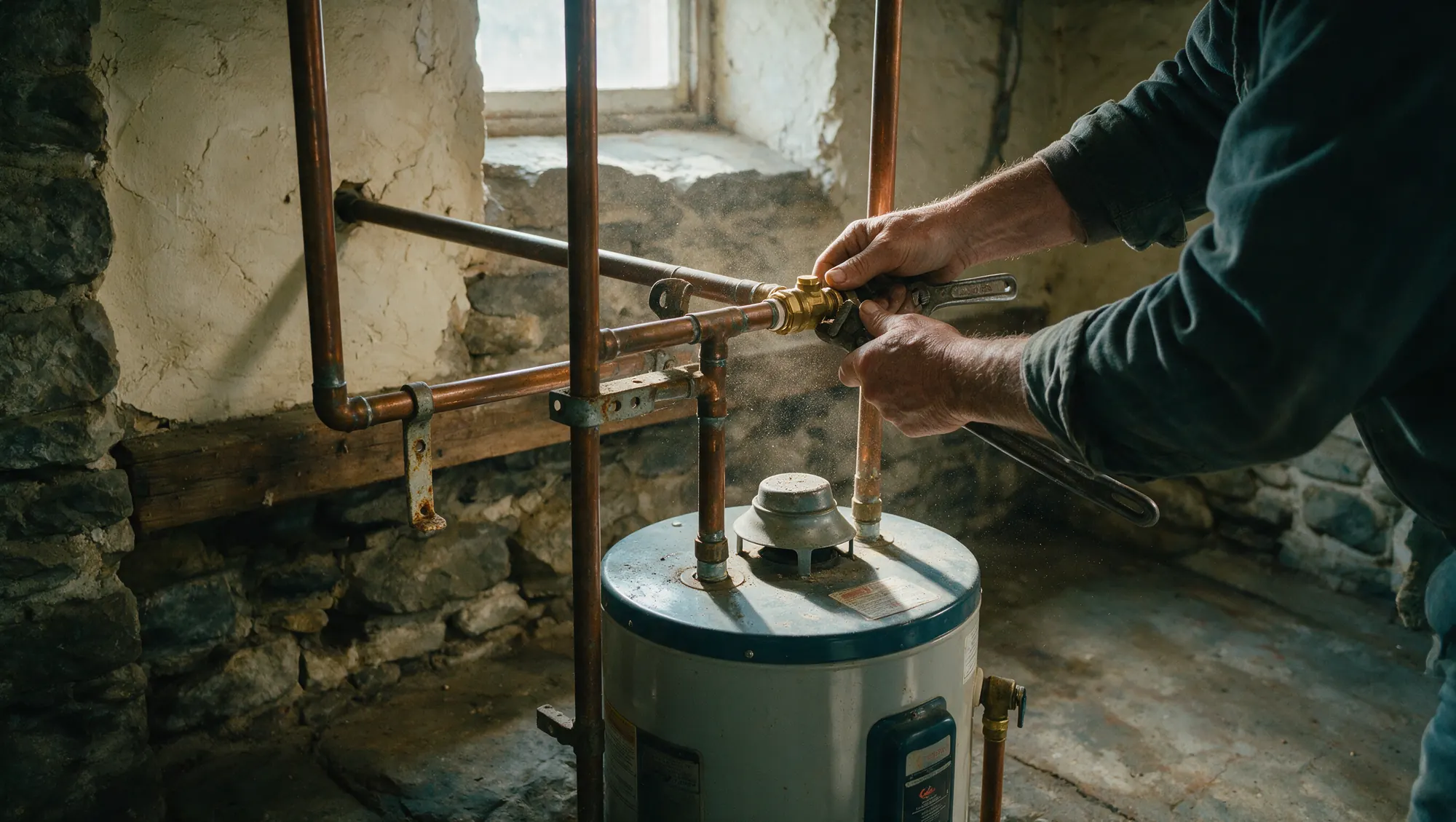
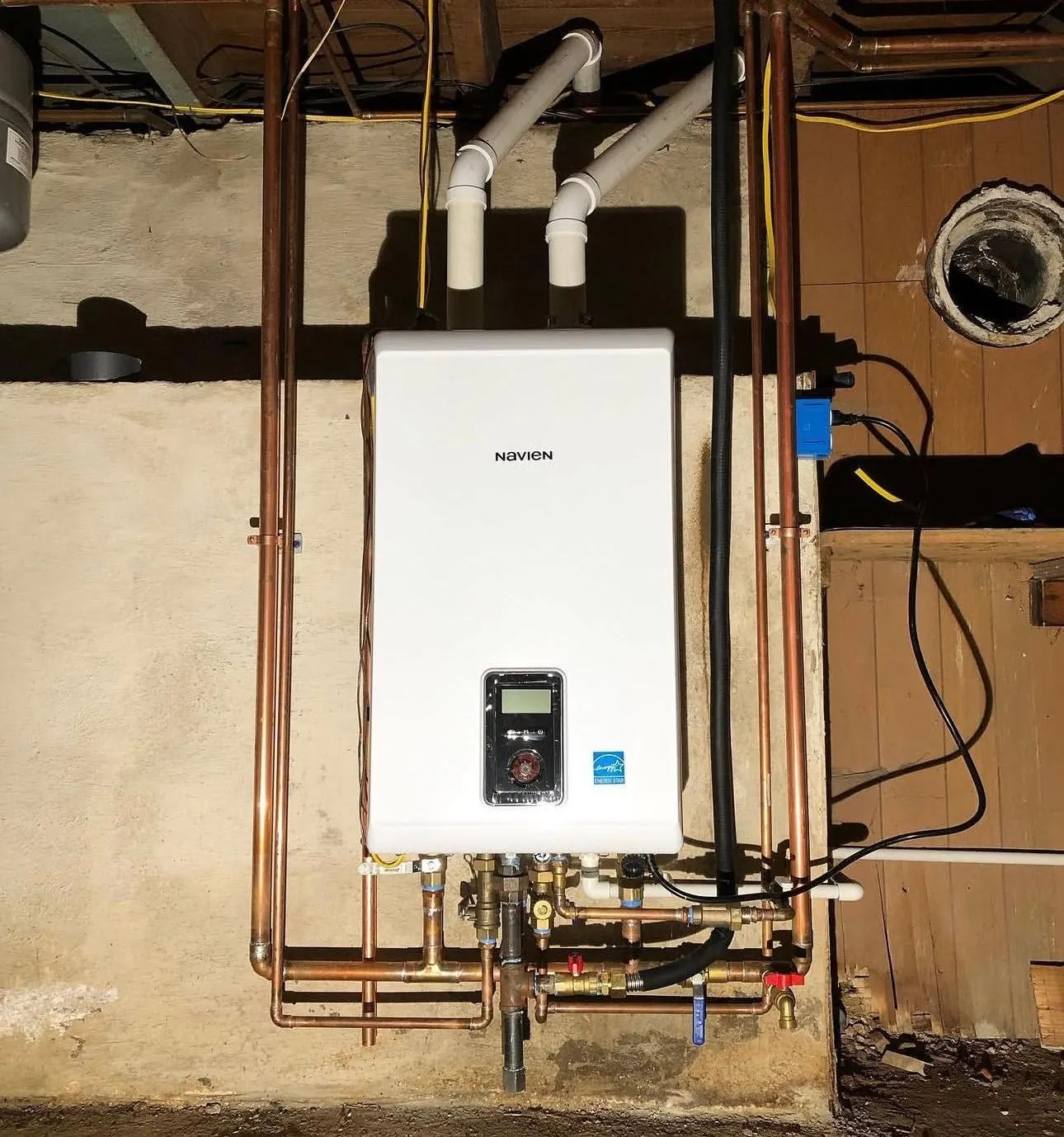
Water heaters nearly always announce their own ending. The recovery slows. The first draw of the morning has a rust tint. Something rumbles down there when the burner fires. The trouble is that all of it happens over months, and the eye is very good at not noticing gradual things in a basement.
Then it goes, usually at the worst hour, and a job that could have been a scheduled Tuesday becomes a wet-vac and a ruined carpet.
You can get ahead of that with about fifteen minutes and a phone camera. Start with how old the thing actually is, because almost every subsequent decision hangs on that number.
Dating the unit from the serial number
There is a rating plate on the side of every heater carrying the model and serial number, and the serial encodes the build date. Manufacturers do not agree on a format, which is why people give up, but the patterns are limited.
- Most common: the first four characters are the year and week or the month and year. A serial beginning 1907 is generally the seventh week, or the ninth month, of 2019 — which one depends on the maker.
- Some brands lead with a letter for the year and a letter or digit for the month. Bradford White is the well-known example of a coded prefix like this.
- A few put a plain four-digit year further along the string, or print a separate build date lower down on the plate.
- If the plate is unreadable: the installer’s sticker, a permit tag, the date on the flexible connectors, or the copyright year on the instruction label.
Photograph the plate rather than transcribing it, and look up the maker’s serial chart — every one of them publishes one. As a benchmark, a conventional tank runs about eight to twelve years, a tankless unit fifteen to twenty when it is descaled on schedule.
How a tank actually dies
The inside of a water heater is ordinary steel with a thin glass lining sprayed onto it, and that lining always has flaws — at the weld seams, around the fittings, wherever coverage was thin. So the tank comes with a sacrificial anode rod, a bar of magnesium or aluminum hung down the middle, that corrodes preferentially so the exposed steel does not. Everything below follows from that rod running out.
- The anode is consumed. On hard well water this can happen inside three to five years.
- Bare steel rusts at the flaws in the lining, while minerals dropping out of solution build sediment across the bottom.
- The heater begins to rumble and pop — that is water flashing to steam under the sediment layer.
- Recovery slows, hot water runs out sooner, and the energy bill creeps.
- Rust appears in the first hot draw of the morning, then all the time.
- A weep starts at a fitting or a seam. A few drops a day.
- The tank splits. Forty to eighty gallons hits the floor, and the supply keeps feeding it.
Steps one through five are years long. Step seven takes ninety seconds. That asymmetry is the entire argument for paying attention to the early ones.
Sediment and the anode rod
Sediment is dissolved mineral coming out of solution when the water is heated, and it settles where the water is stillest — the bottom of the tank. On a gas heater that is directly above the burner, so the flame heats scale instead of water and the steel above runs hotter than it was designed to. On an electric heater it buries the lower element, which burns out. The flush is the cure: hook a hose to the drain valve and run water off until it comes clear, yearly on public water and twice yearly on a well.
The anode is the higher-value job and almost nobody does it. Pull it at three or four years and look. If it has thinned to a wire core or lost half its material, a new one costs a fraction of a heater and can add years to the tank. Expect it to be tight — a long breaker bar, sometimes an impact wrench. Where there is no headroom above the tank, a segmented flexible anode goes in where a straight rod cannot.
Why hard water shortens the life
Hardness is dissolved calcium and magnesium, measured in grains per gallon, and much of the groundwater across the limestone valleys here runs hard to very hard. Everything above 7 grains per gallon accelerates the process above: more scale on the bottom, more on the elements, hotter steel, faster anode consumption.
Softening genuinely extends heater life. But there is a wrinkle that catches people out: softened water is more aggressive toward the anode rod, so a softener plus a standard magnesium anode can consume the rod faster and bring on the sulfur smell described above. That is not a reason to skip softening. It is a reason to check the anode more often afterwards, and a point we raise when talking through water treatment for a house on a well.
Repair or replace, without the guesswork
The arithmetic is mostly about age against the size of the part.
- Under six years: repair, nearly always. Elements, thermostats, thermocouples, gas valves, dip tubes and relief valves are all sensible spends on a young tank.
- Six to ten years: it depends what broke. An element or a thermocouple is small money and buys real time. A gas control valve or a burner assembly is a large share of a replacement, going into a tank already most of the way through its life.
- Ten years and up: think hard. Repairing a twelve-year-old heater leaves you with a twelve-year-old heater and a new part in it. Sometimes that is still the right call — if money is tight this month, a small part that gets you through the winter is a perfectly good decision, and we will fit it and say so.
- A leaking tank body: replace. There is no patch, weld or sealant that safely holds a pressure vessel with 140-degree water in it. If the water is coming from the shell rather than a fitting, it is over.
Two things usually get left out of the decision. Is the heater still the right size — a 40-gallon tank in a house that added a bathroom is not broken, just outgrown. And is the installation correct: relief valve piped to within six inches of the floor, proper venting on a gas unit, an expansion tank if the incoming service has a check valve or a pressure reducer. Those get put right during a water heater replacement, and they are worth knowing about beforehand.
Warning signs, in order of seriousness
- Water on the floor from the tank body. Shut the cold inlet and the fuel or breaker now, and plan a replacement today, not next month.
- The relief valve discharging. A safety device doing its job, which means a runaway thermostat or thermal expansion with nowhere to go. Never cap or plug that discharge.
- Rusty hot water that is not present on the cold side. The tank is corroding internally.
- Rumbling and popping on every heating cycle. Heavy sediment, and the steel is being overheated.
- Noticeably slower recovery or hot water running out earlier than it did last year.
- A rotten-egg smell on the hot side only. Anode chemistry, and cheap to fix.
- Age past twelve with no service history. Nothing is wrong yet — it is simply time to decide on your schedule instead of the tank’s.
- Tank life
- 8–12 years
- Tankless life
- 15–20 years, descaled on schedule
- Check the anode
- Every 3–4 years
- Flush
- Yearly, or twice yearly on well water
- Set the thermostat
- 120°F